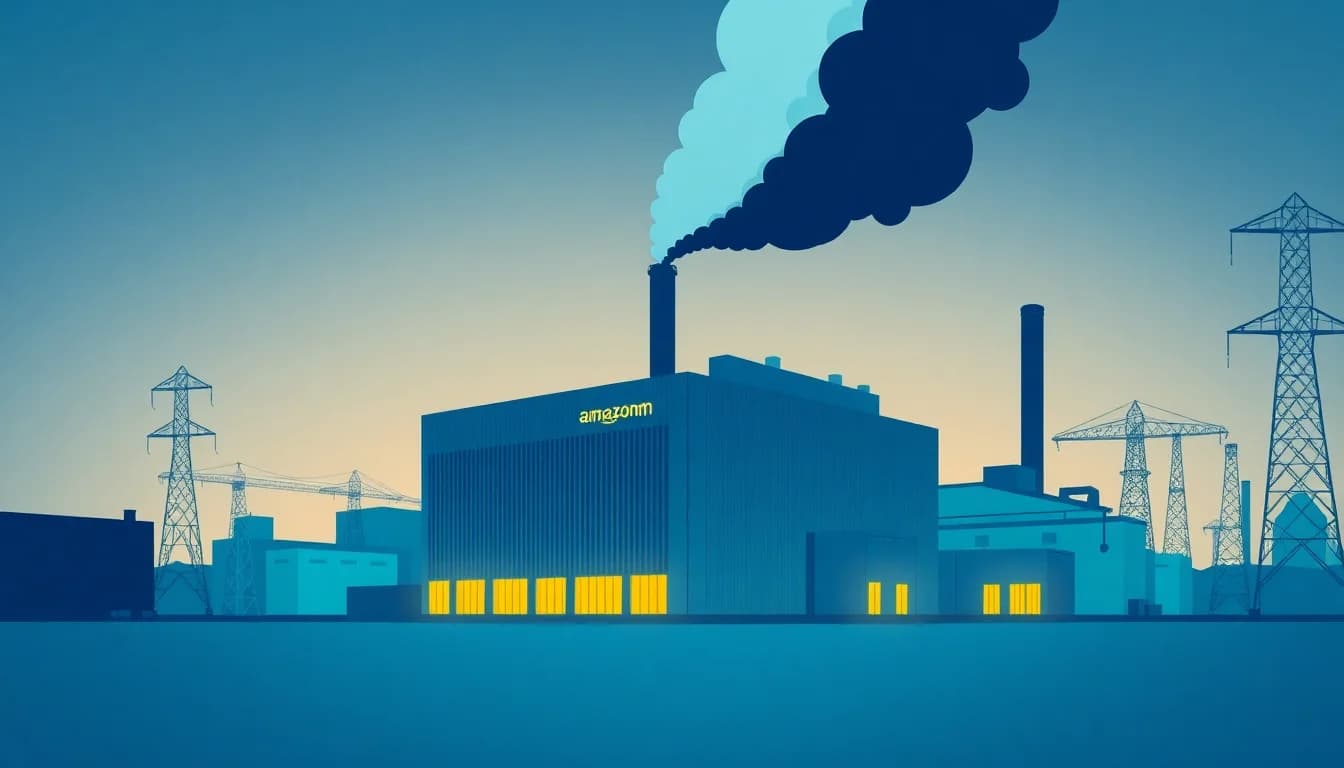
Amazon has confirmed the acquisition of land in Pecos County, Texas, intended for a data center campus powered by a 7.65 GW gas power station. The announcement was made by the analytical service Cleanview.
The GW Ranch station is being constructed by Pacifico Energy. According to the permits filed, the site will feature 35 gas turbines. Currently, there are no operational facilities of this scale in the U.S.; a larger 9.2 GW project in Ohio, involving SoftBank, is designed to connect to the grid.
The campus is being developed through Amazon Data Services. Applications submitted to the Texas Department of Licensing and Regulation include plans for three buildings totaling approximately 17,560 square meters, with an investment of $900 million (about $300 million per building).
Construction is scheduled from August to December 2026. The cost of the land remains undisclosed.
Analysts discovered the project through satellite imagery, correlating three recently submitted permits with a cleared area near the construction site, which was documented on July 24.
Source: Cleanview.Why Companies Are Moving Away from the Grid
Integrating into the Texas energy grid (ERCOT) is a lengthy process, with connection requests processed on a first-come, first-served basis, and timelines determined by the operator. Building a dedicated gas power plant allows companies to bypass these limitations, as the facility is constructed for specific needs and can be operational much faster.
Subsequently, Amazon plans to transition to power from main grid networks when connection conditions permit.
“Amazon believes in paying the full cost of energy supply for its facilities. Our new data center campus in Pecos County achieves this: it is powered by new generation on-site, which will not increase electricity bills for Texas families,” stated company representative Margaret Callahan.
Network operators have incorporated the costs of new infrastructure for AI workloads into rates, leading to increased bills for American consumers.
In response, the industry has begun exploring autonomous energy supply, with xAI, founded by Elon Musk, being the first to implement this practice in 2024 by deploying mobile gas turbines at its data center in Memphis. This project currently accounts for a significant portion of the 2 GW of operational isolated capacity.
According to Cleanview, since early 2025, data center developers have announced nearly 60 such projects with a combined capacity of 90 GW. Major operators, including Microsoft, Google, Meta, and Oracle, have collectively announced around 97 GW of such capacities. The implementation of these projects is expected to result in over 200 million tons of CO₂ emissions annually, comparable to the emissions of 45 million cars or the entire country of Pakistan.
Combined capacity of announced self-sufficient data centers, GW. Source: Cleanview.The rapid development of autonomous generation is also encouraged by governmental positions. Previously, former U.S. President Donald Trump signed an executive order simplifying the construction of data centers, and federal agencies have since introduced expedited approval procedures.
Texas is a Battleground for AI Companies and Miners
The state has become a key location for such construction, offering available land, simplified approval processes, and gas infrastructure.
Located 48 km west of Amazon's site, Microsoft, in partnership with Chevron, is building a 2 GW campus with autonomous gas power, announced in June. Near Fort Stockton, AI startup Poolside is developing the Horizon project on 226 hectares and 2 GW, which was announced in October 2025 alongside CoreWeave, though the latter has since exited the project.
Separately, Amazon is negotiating for a 4.5 GW station in Homer City, Pennsylvania.
The same model has previously been adopted in the crypto industry, where bitcoin miners have occupied sites near sources of cheap energy and connected directly to them for years. Now, AI developers are vying for such sites, while miners are repurposing their capacities for high-performance computing.
In July, Galaxy Digital completed the first phase of converting its Texas Helios campus from mining to AI, transferring 133 MW of critical IT load to CoreWeave. MARA Holdings announced the acquisition of the Long Ridge energy complex in Ohio for $1.5 billion, and SpaceX is establishing its own gas stations for the Terafab plant in Texas.
Permit for 33 Million Tons of Emissions
Aside from construction permits, the project received an emissions permit in January. Texas has allowed the station to emit up to 33 million tons of carbon dioxide annually, which accounts for about 5% of Canada's yearly emissions. Additionally, the permit permits over 12,000 tons of regulated pollutants annually, including soot, ammonia, carbon monoxide, and volatile organic compounds.
For comparison, the current leader in the U.S. is the James Miller coal plant in Quinton, Alabama, which emits around 16 million tons.
Burning coal results in higher emissions per unit of energy produced compared to gas, but the Amazon station exceeds the scale of the Alabama facility. Both types of generation release pollutants that contribute to smog and are associated with cardiovascular diseases and asthma.
“This will have a colossal impact on the environment and public health,” said Katherine Guerra, director of campaigns at the advocacy organization Public Citizen.
Amazon is considering installing solar panels and energy storage systems, and plans to utilize brackish groundwater (unsuitable for drinking) to reduce the burden on the local watershed. Pacifico Energy has also announced intentions to build up to 750 MW of solar generation and storage capacity of 1.8 GW at GW Ranch.
However, this project contradicts Amazon's climate commitments under the Climate Pledge initiative, of which it is a co-founder. According to the initiative's terms, the company must achieve carbon neutrality by 2040, but emissions have increased in recent years. Amazon has previously acknowledged that AI workloads may hinder this goal.
“The world looks different now than when we co-founded the Climate Pledge. But our commitments have not changed,” stated Callahan.
To reaffirm its intentions, the company highlighted 40 carbon-free energy projects totaling nearly 10 GW that are being supported in Texas.
In August, Reuters reported that the AI boom has resulted in Microsoft, Meta, Oracle, Amazon, and Alphabet facing commitments totaling $1 trillion.