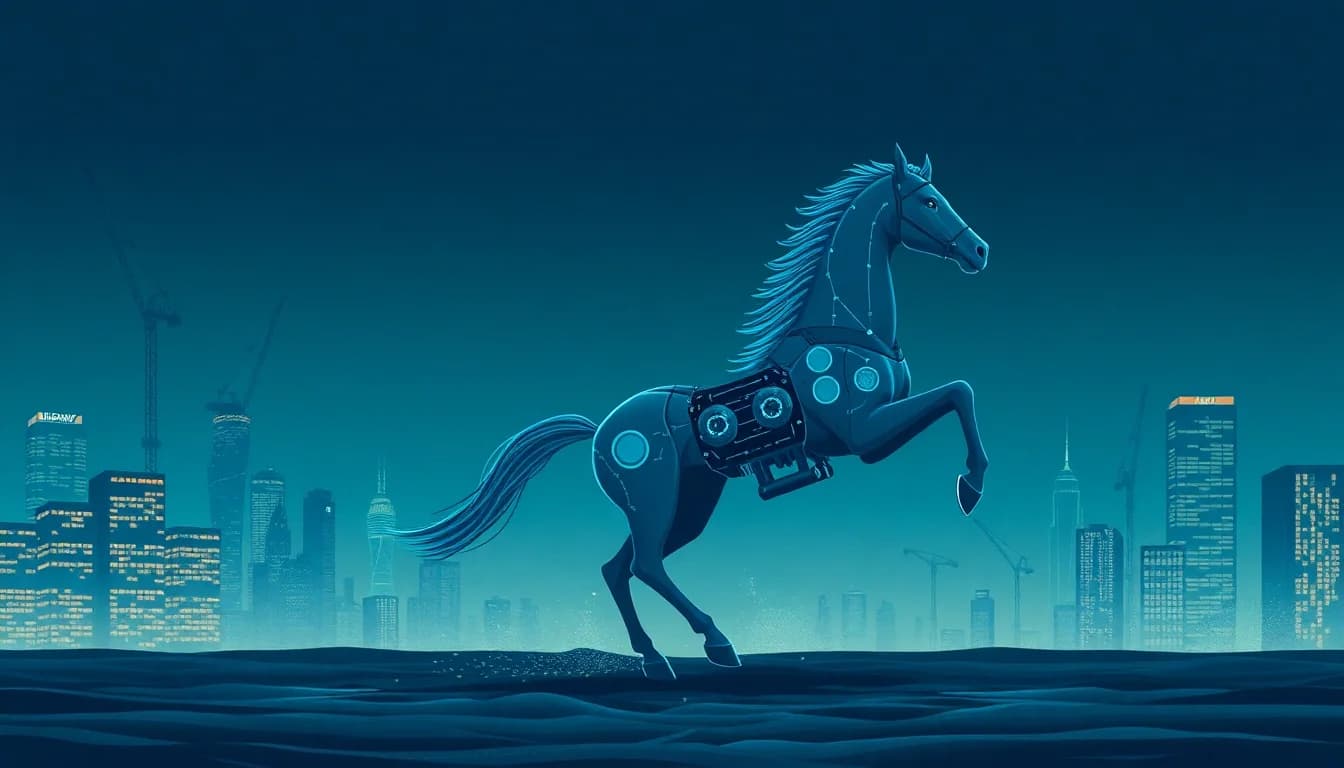
Imagine a delivery truck driver whose every move is monitored by AI, which dictates their route and penalizes any deviation from the prescribed path. In this scenario, the driver is not in control of the vehicle; rather, the vehicle controls the driver.
In his book, The Reverse Centaur's Guide to Life After AI, author Cory Doctorow describes this phenomenon as the "reverse centaur problem." This article explores the inverted myth and the implications of turning humans into hybrids.
Understanding the Centaur Classification
Doctorow’s book is built on a dichotomy that categorizes human-machine interaction into two models: the "centaur" and the "reverse centaur."
Centaur refers to a human enhanced by technology. In automation theory, this describes a symbiotic relationship where machines aid in enhancing human capabilities, making them better, more productive, and efficient. Examples include bicycles, hearing aids, and text editor autocomplete features.
In this model, the human remains the decision-maker while the machine acts as the body carrying out tasks. Doctorow believes that this centaur model benefits people.
Reverse centaur represents a complete inversion: a "mechanical head on a human body." In this setup, the human becomes an adjunct to the technology, losing control over their work.
Doctorow defines a reverse centaur as a person "drafted to serve as an assistant to the machine, at a pace that is inhuman and mechanical."
Cover of The Reverse Centaur's Guide to Life After AI. Source: Cory Doctorow's craphound.The term "centaur" was borrowed from chess grandmaster Garry Kasparov, who, after losing to the supercomputer Deep Blue in 1997, proposed a new format for "advanced chess" where humans and AI collaborate against another team. This mythological creature symbolizes the synergy between the player and the machine.
Kasperov found that a grandmaster empowered by AI consistently outperformed both standalone AI and human players. The centaur proved to be stronger than either entity alone.
As technology has evolved, the risks associated with this type of collaboration have become evident, which Doctorow highlights. The concern is no longer whether machines can enhance efficiency, but rather whom they serve.
"The future may belong to humans if we never forget that the most important aspect of technology is not what it does, but who it serves and for what purpose," Doctorow notes.
Reverse Centaurs in Today's Workforce
Doctorow moves from definitions to examples of AI's "parasitic" influence, based on his observations. He emphasizes that reverse centaurs are not just abstract figures from a dystopian future, but a reality in today's economy.
Drivers and Warehouse Workers
A clear example is manual labor workers who operate under algorithmic control.
Doctorow mentions the case of an Amazon driver whose van is equipped with AI cameras that monitor every action. For instance, the system checks if the driver is distracted by their phone or singing while driving (both prohibited by corporate policy).
The algorithm maps out the route and sets time benchmarks. As Doctorow points out, sometimes the system's demands "require superhuman endurance." Drivers are compelled to skip breaks for meals and restroom visits to meet the schedule. Here, the human performs tasks that machines cannot, while all "administrative" decisions are made by AI.
Interior of an Amazon delivery van. Source: Reddit.A similar situation occurs in warehouses, where algorithms assign tasks, monitor performance, and track violations. Workers must adapt to the machine's pace rather than their own.
"Automation is not necessarily an enemy of warehouse work: there's nothing wrong with a forklift! The difference lies in whether a warehouse worker can choose when, where, and how to use that automation. That’s the distinction between a centaur and a reverse centaur," Doctorow emphasizes.
Programmers and Developers
In software development, the introduction of automatic coding tools (like GitHub Copilot or Codex) creates a new type of reverse centaur. Doctorow provides an example where programmers are pressured to "produce impossible volumes of code" with AI assistants.
Here, developers do not so much drive the creation process as they verify and adjust the generated code. They shift from creators to monitors, with the pace and volume of tasks often dictated by AI tools rather than human capabilities.
Human-in-the-Loop
Doctorow highlights a systematic case involving workers tasked with verifying AI outputs.
In law firms, healthcare institutions, and financial companies, a system is increasingly used where AI generates drafts of solutions or documents, which experts must then review and approve. In practice, this means specialists must process large amounts of content at "superhuman speed."
Moreover, they bear full responsibility for AI errors. In this situation, the reverse centaur "absorbs friction and takes on the accountability when things go awry," explains the author.
Verification becomes a task that can be as labor-intensive as completing the original task but lacks creativity and involves constant stress due to the unpredictability of algorithms.
Media and Creative Professionals
In the modern media industry, Doctorow observes a trend where three hypothetical journalists equipped with AI tools must produce the same content volume that previously required ten employees.
AI generates drafts of news articles, stories, and headlines, while journalists serve as editing verifiers. Their role shifts from creation to filtering and correcting, with volume and speed metrics remaining dictated by machines.
"Any editor who assigns a freelancer to 'write' most of a 64-page summer guide implicitly, or explicitly, instructs that author to limit their efforts to prompting a chatbot to spew out a bunch of plausible-sounding words and shape them into form," Doctorow added.
All these examples illustrate a "power asymmetry." Humans still bear responsibility for outcomes but lose control over the processes. Technology does not relieve them of labor; instead, it reshapes the work mechanism (often increasing intensity and reducing autonomy).
Economic and Ethical Implications
Doctorow argues that the rise of reverse centaurs is a systemic outcome of economic incentives. Employers face "funny arithmetic": ten employees can be replaced by three equipped with AI tools.
The remaining workers are forced to handle workloads comparable to before, but now they also have the task of verifying machine-generated results. Savings are realized not through actual labor efficiency gains, but by redistributing the workload to the remaining staff and shifting risks and responsibilities onto them.
"Your boss almost certainly loves AI," the author asserts.
Decision-makers implementing these technologies rarely become reverse centaurs themselves, as they occupy higher positions in the corporate hierarchy. For them, AI is a management tool, not a subordinate one. This helps explain why AI adoption meets resistance at lower levels while being embraced at the top.
Major AI corporations also drive the spread of reverse centaurs. Doctorow warns of a financial bubble surrounding artificial intelligence, estimating it at $1.4 trillion.
The seven largest AI companies account for more than a third of the stock market, with their business models largely dependent on mutual obligations and expectations of future profits.
Largest AI companies. Source: CompaniesMarketCap.According to the author, the bubble will inevitably burst, leaving behind only a "useful residue" — cheap open models that work on personal computers, suitable for localized tasks like transcription or image processing.
"Even if you ultimately reject AI so radically that the investment bubble bursts, the people who drive the agendas for their companies will either have long since left (with enough money to create a dynastic legacy lasting for centuries) or will find another bubble to inflate," Doctorow believes.
A key economic paradox discussed by the author relates to verification. If every AI output requires human validation, and errors are unpredictable and unevenly distributed, the cost of such labor may equal that of performing the task independently.
Savings arise only when the employer offloads verification costs onto employees, compelling them to work faster and longer without additional compensation. At this point, the reverse centaur becomes a source of profit.
Social Consequences
The transformation into a reverse centaur entails not only physical and psychological burdens but also more severe effects on humanity as a whole.
Doctorow refers to this as "renouncing our humanity." People lose autonomy in decision-making, are stripped of creativity, and become executors of algorithmic commands rather than subjects of professional activity.
Accountability for AI errors is another crucial aspect. Who will bear the consequences of a more significant machine failure beyond just missing a deadline? Such pressure on employees can lead to chronic stress and rapid burnout.
Moreover, Doctorow notes that the perception of AI's usefulness directly correlates with whether the tool is used voluntarily or imposed. AI advocates typically decide when and how to utilize it. In contrast, those who view it as useless or harmful are often compelled to use it by mandate.
Empowering Ourselves
Doctorow does not delve into extremes, avoiding dystopian scenarios. However, he emphasizes the importance of responsibly handling technology and outlines two levels of resistance against negative consequences.
The first is individual. This idea promotes the conscious use of AI as a tool rather than submitting to it. It is crucial to maintain critical thinking, verify algorithm results, and advocate for labor rights.
On a political level, regulatory initiatives are needed that consider not only AI safety but also its application goals. Doctorow believes the European approach currently focuses on risks but overlooks power distribution. Workers should have a voice in the implementation of automation systems, not just the right to monetary compensation during layoffs.
Doctorow predicts that after the collapse of the AI bubble, a genuine opportunity for the "centaur" model will emerge — a human who employs technology as a tool.
"The essence is this: the future is ours. It is not inevitable. Artificial intelligence is not a genie that cannot be put back in the bottle. How we choose to use AI depends solely on us," Doctorow concludes.