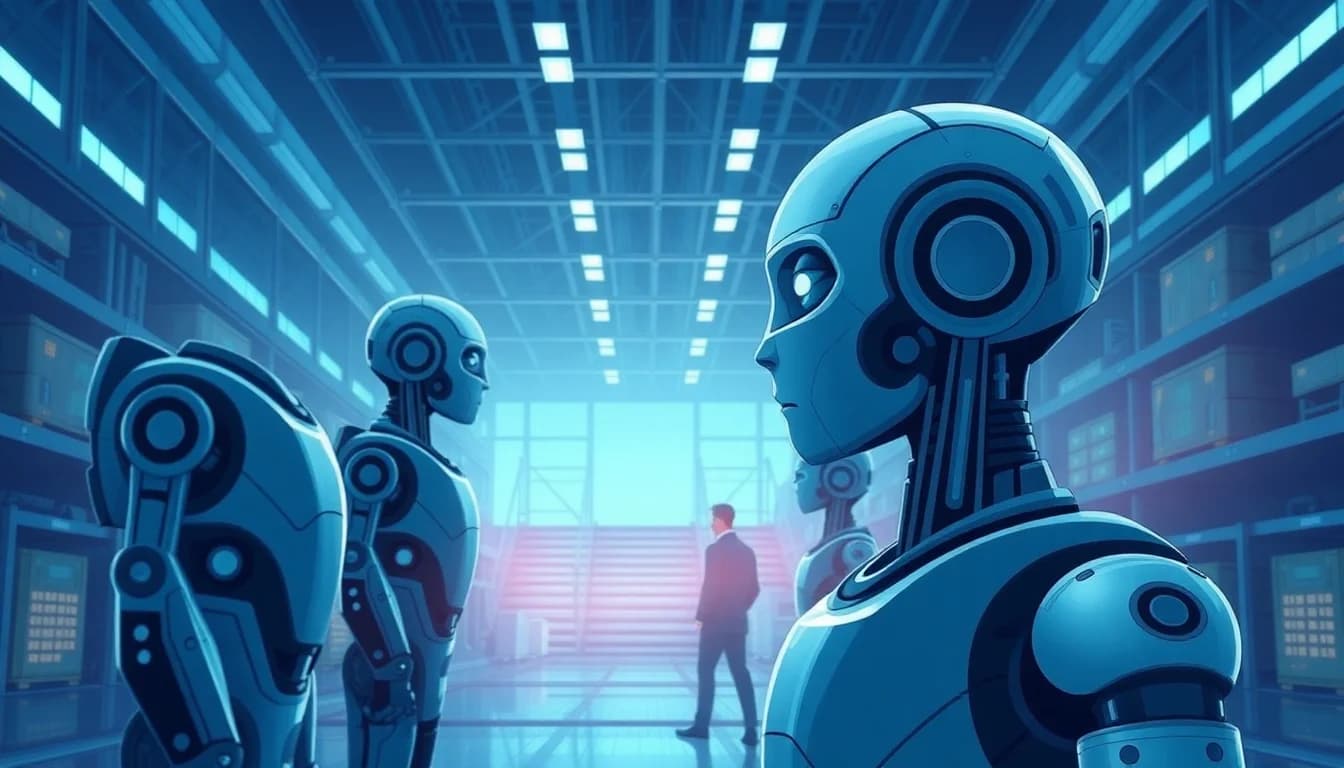
JPMorgan forecasts U.S. humanoid robot production could hit 400,000 units by 2030, driven by demand from industries facing labor shortages.
According to a recent report by JPMorgan, the annual production of humanoid robots in the United States could reach between 300,000 and 400,000 units by 2030, potentially escalating to around 1.5 million by 2035. This forecast arises as the industry shifts from prototypes to commercial applications.
The primary users of this technology are expected to be industrial firms, logistics operators, and warehouses, where robots will be deployed to perform repetitive tasks and address labor shortages.
Cost Competitiveness of Humanoid Robots
JPMorgan analysts suggest that the cost of utilizing humanoid robots is approaching that of human labor. Utilizing these robots in multi-shift operations could save companies approximately $100,000 annually. Businesses value the ability to operate a single machine continuously without breaks, although integrating humanoids into existing workflows will require additional investments in technical support and safety measures.
Despite the optimistic outlook, the widespread adoption of humanoid robots in households remains a distant prospect, with corporate clients likely driving demand first.
Challenges to Mass Production
Several technical hurdles currently limit the scaling of humanoid robot production. According to JPMorgan, key factors include advancements in robotic hands, actuators, artificial intelligence, and manufacturing capabilities.
"Progress is hindered by challenges such as robotic dexterity, joint actuation, and the intelligence of robots," the analysts noted.
Developing effective robotic hands is particularly challenging, as they must manipulate objects of various shapes and sizes with precision. Actuators are crucial for joint movement, influencing speed, accuracy, and load handling capabilities.
Moreover, high-quality data and sufficient computational resources are essential for robots to function autonomously in dynamic environments. Currently, most U.S. humanoid robot manufacturers, except for Tesla, plan to produce only 10,000 to 30,000 units annually.
Key players in the market identified by analysts include:
- Tesla with its Optimus model;
- Agility Robotics with Digit;
- Boston Dynamics with Atlas;
- Figure AI and Apptronik with Apollo.
However, the production goals set by these companies do not guarantee actual output, as they still need to establish reliable mass production processes.
Component Market Growth
JPMorgan anticipates that component suppliers will benefit significantly from the growth of humanoid robot production. By 2035, the market for essential components such as actuators, motors, and computer vision systems could approach $30 billion.
Promising companies in this segment include Timken, Robotis, Leader Drive, Orbbec, and Cognex, which specialize in various robotic elements ranging from mechanical parts to sensors and machine vision technologies.
As the industry evolves, JPMorgan expects a gradual shift in value creation favoring manufacturers of complete robots and those integrating hardware with software platforms.
Trade policies may also impact U.S. production, with analysts suggesting that concerns over national security regarding robotics imports could lead to new tariffs or other measures to support domestic manufacturers.
JPMorgan’s forecast indicates a significant expansion for an industry that is still in its infancy, with only about 7,000 full-sized humanoid robots sold globally in 2025 for commercial and professional purposes, according to the International Federation of Robotics.
In January, Tesla announced plans to convert its Fremont factory for Optimus production, targeting an annual output of 1 million robots. Meanwhile, in August, the Chinese company AgiBot emerged as the global leader in humanoid robot sales for the first half of 2026, delivering around 8,400 units and capturing a 44% market share, while Unitree fell to second place with approximately 5,900 units sold, holding 31% of the market.