Key Highlights
- FutureBit’s HashFly employs 2,914 simulated neural pathways to execute Bitcoin hashing tasks.
- This browser-based experiment runs on standard hardware and is not competitive with dedicated ASIC miners.
- An additional initiative, FlyMiner, utilizes simulated neural signals to determine when a conventional hashing engine should operate.
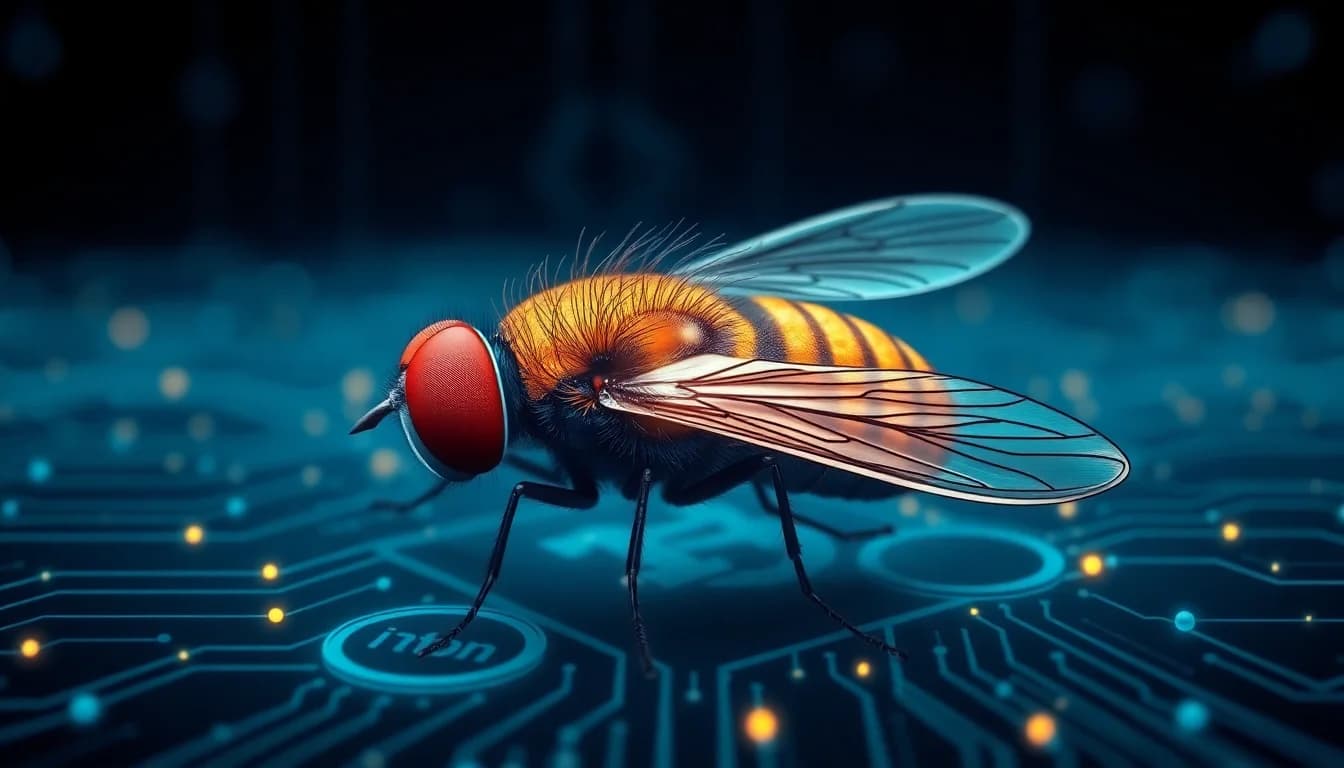
As the demand for more efficient Bitcoin mining chips rises, FutureBit is experimenting with an unconventional method: simulating a fruit fly brain to conduct mining computations through a web browser.
The HashFly demonstration mimics activity across 2,914 neural pathways derived from MaleCNS v1.0, a digital schematic of an adult male fruit fly's brain and central nervous system.
Myriad: What will be Bitcoin's peak? Make your prediction here.FutureBit announced on X that they aim to simulate all neurons in the dataset using SHA-256 and intend to share their results later.
“Interesting fact: if this could be scaled with actual organic neurons, it would hash at around 1 watt per terahash... ten times more efficient than the best 3nm ASICs,” the company stated.
Introducing HashFly... the first organic neuron Bitcoin miner inspired by the fruit fly brain.
Interesting fact: if this could be scaled with actual organic neurons, it would hash at around 1 watt per terahash... ten times the efficiency of the best silicon 3nm ASICs! pic.twitter.com/T2qxBb7XQR
— FutureBit (@FutureBit) September 13, 2026
This suggests that a mining setup utilizing living neurons could achieve one trillion calculations per second while consuming just one watt of power—approximately ten times more efficient than top-performing 3-nanometer ASIC miners. This estimate considers the total energy usage of a fruit fly applied to a theoretical model where each neuron continuously mines Bitcoin.
Despite its biological inspiration, the current experiment is conducted on standard computer hardware and does not possess the hash rate necessary to compete with established Bitcoin miners.
In the Bitcoin mining arena, miners aim to add transaction blocks by executing repeated SHA-256 calculations, with hash rate indicating the number of attempts per second. HashFly allows users to modify the target but operates at a significantly lower difficulty than current Bitcoin mining; for instance, FutureBit claims its five-inch Apollo III ASIC miner achieves a hash rate of 18 terahashes per second.
A different initiative known as FlyMiner leverages a digital map of 139,255 fruit fly neurons and 16.8 million connections to manage a traditional Bitcoin mining program. The program activates when signals from the fly’s movement-control neurons surpass a certain threshold, testing potential solutions to mining challenges posed by the solo mining pool CKPool, at speeds of up to 700,000 attempts per second.
The fruit fly projects represent the latest in a series of novel Bitcoin mining experiments.
In March 2021, an IT security expert transformed a 1989 Nintendo Game Boy into a Bitcoin miner, producing approximately 0.8 hashes per second. In June 2023, a Brooklyn bathhouse reported that it was using heat from mining equipment to warm its pools, while Utah-based Nodal Power secured $13 million in funding in August 2023 to enhance facilities utilizing landfill methane to generate electricity for Bitcoin mining.