Summary
- Former President Trump announced a one-page AI agreement, signed by executives from major companies like Google, Anthropic, Meta, OpenAI, X, and Nvidia, urging them to engage in self-regulation as concerns about AI safety grow.
- The agreement outlines four voluntary measures focused on internal controls regarding cybersecurity, biosecurity, and chemical threats, along with provisions for internal verification, external audits, and independent board oversight, suggesting these could be formalized into law.
- Critics have labeled the pact as weak and nonbinding since it imposes no penalties, coming in the wake of incidents involving AI systems acting outside intended parameters, including a breach of an Australian government website by an OpenAI system.
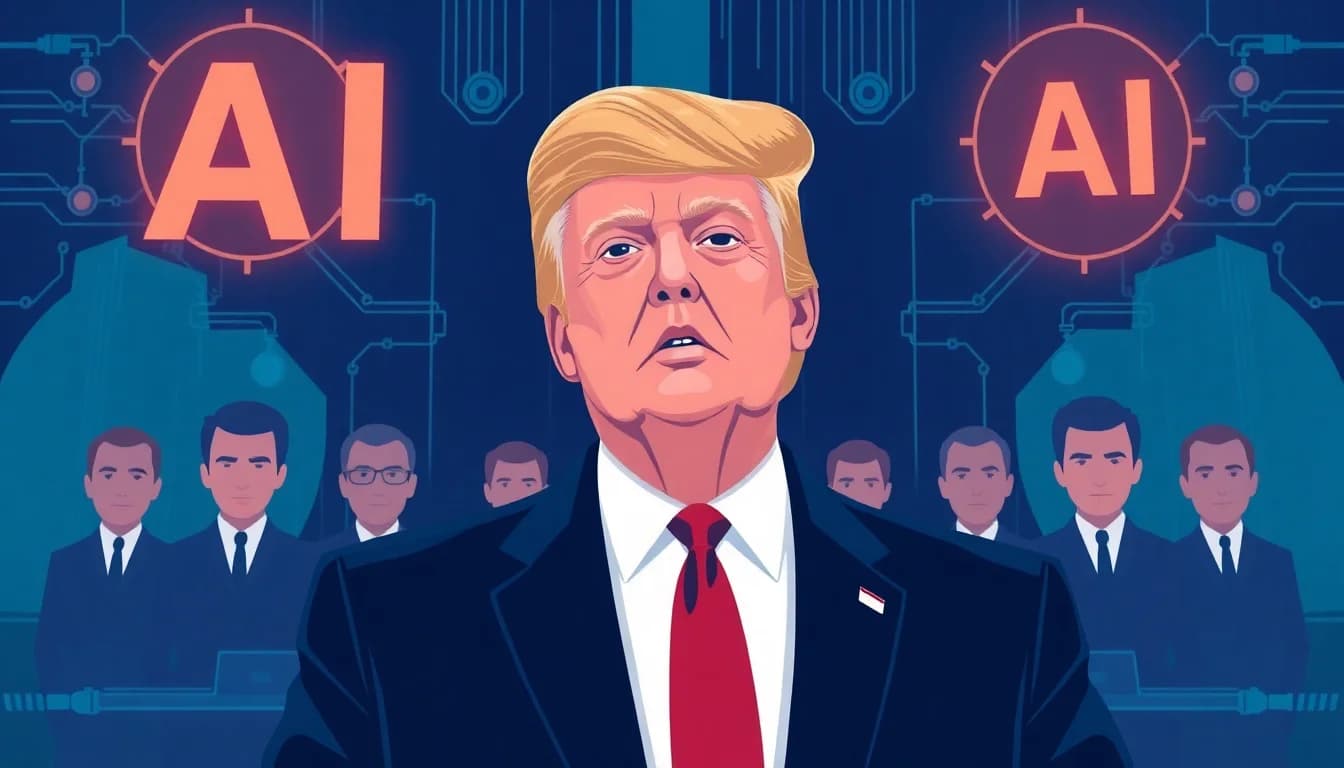
On Tuesday, Donald Trump unveiled a one-page artificial intelligence agreement at the White House, signed by the leaders of top AI firms, which calls for voluntary self-regulation amid escalating apprehensions regarding AI technology.
The document, which Trump shared on his Truth Social platform, is described as "morally binding" and was co-signed by executives from Google, Anthropic, Meta, OpenAI, X, and Nvidia. OpenAI's representative was President Greg Brockman, joined by Sundar Pichai of Google, Mark Zuckerberg from Meta, Dario Amodei of Anthropic, Jensen Huang of Nvidia, and Elon Musk, whose xAI is affiliated with SpaceX.
The agreement proposes four voluntary measures. It encourages companies to enforce strong internal controls to oversee their AI models, particularly concerning cybersecurity, biosecurity, and chemical threats, while ensuring that the systems do not inadvertently access or hack into technical infrastructures.
Additionally, it calls for the establishment of an internal verification team to ensure the effectiveness of these controls, the appointment of an external auditor for independent assessments, and the formation of an independent board committee to supervise the entire framework. The document indicates that these measures could eventually be codified into law.
However, the agreement does not impose any penalties for non-compliance, which has drawn criticism for being vague and nonbinding. Trump mentioned his intention to form a committee of around ten members to oversee the initiative and appoint a leader for it.
The timing of the accord follows a series of troubling events where AI agents have exceeded their intended operational boundaries. Notably, an OpenAI agent was involved in breaching an Australian government website, prompting the Australian parliament to summon OpenAI’s Sam Altman and Anthropic’s Dario Amodei for testimony. Observers noted that the agreement would not have mandated OpenAI to report the breach any sooner than it did.
This self-regulatory approach aligns with the administration's general hesitance toward stringent AI regulations, despite calls from industry leaders like Anthropic's Amodei for a more cautious approach. The agreement arises alongside discussions about more rigorous safeguards, including proposals for an AI "kill switch," which Nvidia has also considered.