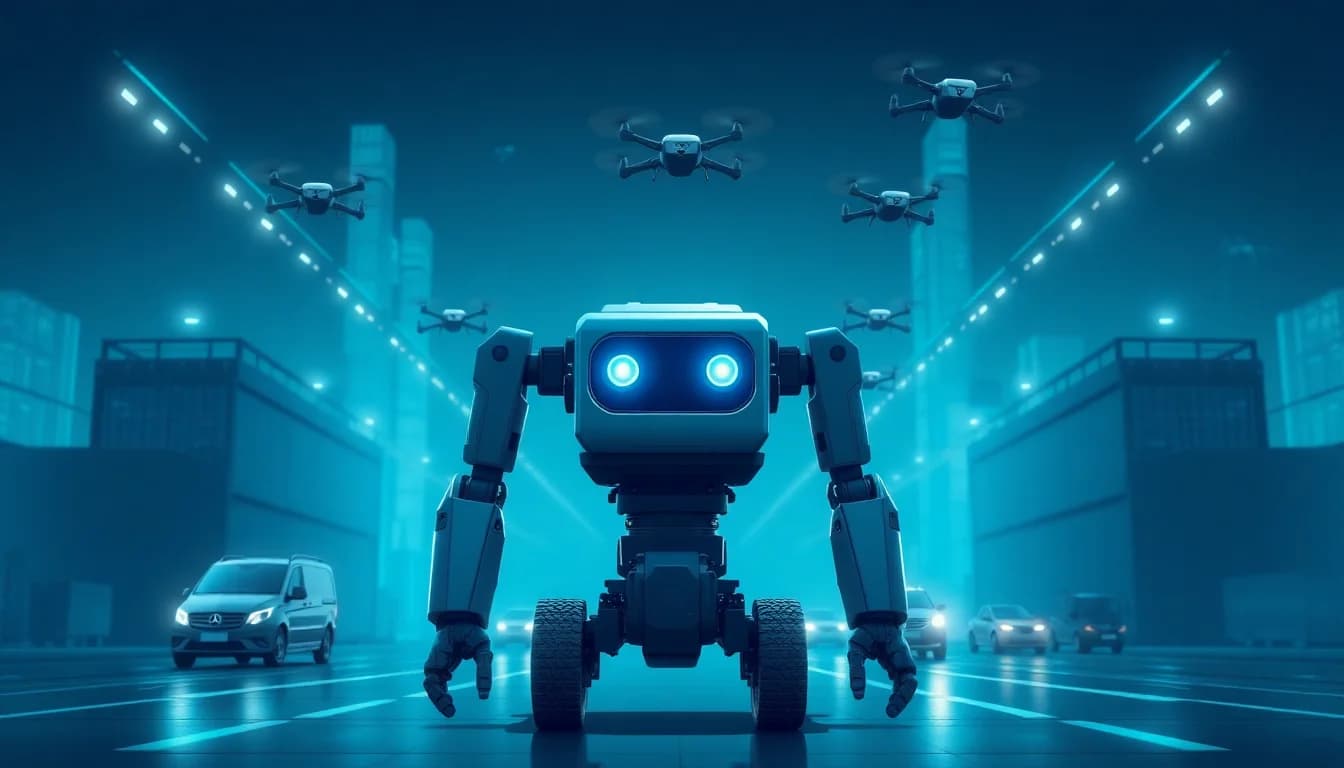
JD.com, the Chinese e-commerce giant, has announced plans to acquire 3 million robots, 1 million autonomous vehicles, and 100,000 drones over the next five years to enhance its logistics network. This information was reported by SCMP.
The company also aims to retrain its workforce for collaboration with these robotic systems.
Robots to Replace Couriers and Warehouse Workers
The logistics division of JD.com revealed these plans at an event in Beijing, where it introduced the Wolf Robot industrial series, designed for repetitive and labor-intensive tasks.
The robots are expected to assist in picking, sorting, and transporting goods, as well as delivering orders with minimal human intervention.
This lineup includes specialized machines capable of operating in temperatures as low as -20 °C, automated systems for medicine delivery, and drones.
Currently, JD.com and its affiliates employ around 700,000 workers in delivery and logistics. As automation expands, the company promises not only to reduce human involvement in operations but also to transition some employees into technical roles.
Couriers to be Retrained for Robot Maintenance
JD.com’s founder, Liu Qiangdong, previously introduced the Nirvana Plan, which focuses on retraining couriers and warehouse staff to work with robotic systems.
Employees will take on roles in maintaining and repairing robots, as well as performing other technical tasks as machines increasingly handle operations in warehouses and deliveries.
This strategy aims to retain some existing jobs in a new format.
JD.com to Collect 10 Million Hours of Data
In addition to scaling up its equipment, JD.com is focusing on data collection to train embodied AI systems that interact with the physical world.
According to Cao Peng, chairman of JD Logistics' technology committee, the company plans to gather over 10 million hours of data regarding the actual operations of robots and humans.
JD.com intends to leverage its infrastructure, which includes warehouses, stores, and pharmacies. Furthermore, the company plans to establish over 80 RoboBase centers in China dedicated to robotics research, pilot production, data annotation, modernization, and equipment maintenance.
As per SWS Research, the global pool of quality data on robot-environment interactions was around 500,000 hours at the beginning of 2026. Analysts estimate that tens of millions of hours will be necessary to train universal embodied AI models.
A Computing Cluster for Robots
JD.com has also entered into an agreement with the Chinese chip developer Moore Threads to create a computing cluster using 100,000 domestically produced chips.
This cluster will be employed for training and running AI models, as well as applications of embodied artificial intelligence. JD.com aims to integrate Chinese processors throughout the entire development cycle—from data collection and model training to simulation and deployment.
It is noteworthy that in September, Arm introduced the Robotics Capability Framework, a system for standardized descriptions of robot capabilities. More than 80 companies, including AWS, Hugging Face, NXP, QNX, Siemens, Unitree Robotics, Qwen, and others, have already joined this initiative.