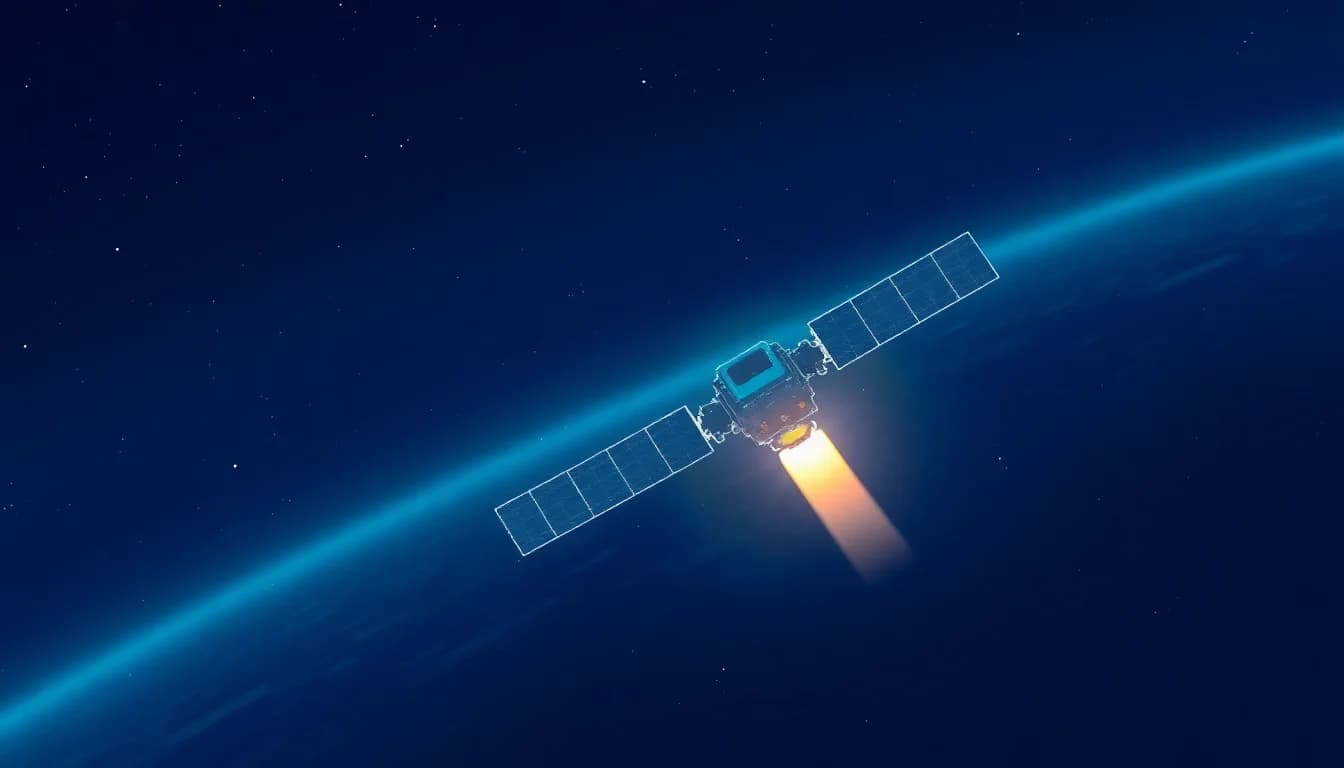
Google is set to launch its experimental satellite, MVP, equipped with its proprietary AI chips. This mission marks the inaugural orbital test of Project Suncatcher, a research initiative aimed at developing computational infrastructure for artificial intelligence in space, as reported by The New York Times.
Google's MVP satellite. Source: The New York Times.The satellite will be deployed into orbit aboard SpaceX's Transporter-18 mission, utilizing a Falcon 9 rocket launched from Vandenberg Space Force Base in California. The MVP was developed in collaboration with Planet Labs.
While not a full-fledged data center, the MVP, which is roughly the size of a refrigerator, carries four Tensor Processing Units (TPUs) that collectively provide computational power equivalent to a single data center server. Solar panels will supply approximately 1 kW of power.
In space, the satellite will handle AI queries and assess the performance of Gemini in orbit. Google anticipates that the satellite will operate for around one year, although it could remain in orbit for up to six years before re-entering the atmosphere and burning up.
Testing Radiation and Vacuum Conditions
The primary objective of this mission is to determine whether Google's standard AI accelerators can function effectively after being launched and under the conditions of radiation and vacuum.
Prior to launch, engineers conducted vibration tests on the satellite across three axes to simulate the forces experienced during flight. According to Google, the equipment successfully passed these tests.
The TPUs were additionally tested with proton beams at the Crocker Nuclear Laboratory at the University of California, Davis. The company reported that the processors withstood a cumulative dose of ionizing radiation exceeding what would be expected over five years in orbit.
Cross-section of Google's MVP satellite. Source: The New York Times.Cooling remains a significant challenge. In a vacuum, heat cannot be dissipated through airflow, prompting Google to devise a system using conductive materials and a radiator to release heat into space. This system has also been validated in a thermal vacuum chamber.
A limitation of the current prototype is that the TPUs can operate continuously for about 15 minutes before needing to be turned off for cooling. This is sufficient for Gemini tasks, but continuous operation akin to a traditional data center is still a way off.
Why Google is Pursuing Space Computing
Project Suncatcher was unveiled by Google in November 2025. The concept involves a constellation of satellites equipped with TPUs and solar panels connected via high-speed laser channels.
On a suitable low Earth orbit, solar panels can generate up to eight times more energy than on the Earth's surface, thanks to near-constant sunlight exposure. This could reduce the reliance of AI infrastructure on terrestrial power grids.
To integrate multiple satellites into a cohesive computing network, extremely fast communication between them is necessary. In laboratory conditions, Google achieved a data transmission rate of 1.6 Tbps on a single optical link, with 800 Gbps in each direction.
In 2027, Google and Planet plan to launch two additional prototypes to test their interoperability, including laser communication capabilities. Future iterations are expected to feature dozens of TPUs per satellite.
However, Google does not anticipate a fully operational orbital AI infrastructure in the near future. The company estimates that as launch costs decrease to around $200 per kilogram, space computing may economically approach terrestrial data centers by the middle of the next decade.
As a reference, in May 2025, China launched 12 satellites for distributed AI computing, and in January 2026, Alibaba Cloud's Qwen-3 was initiated using this infrastructure.
Follow ForkLog on social media
Telegram (main channel) Facebook XIf you find an error in the text, highlight it and press CTRL+ENTER