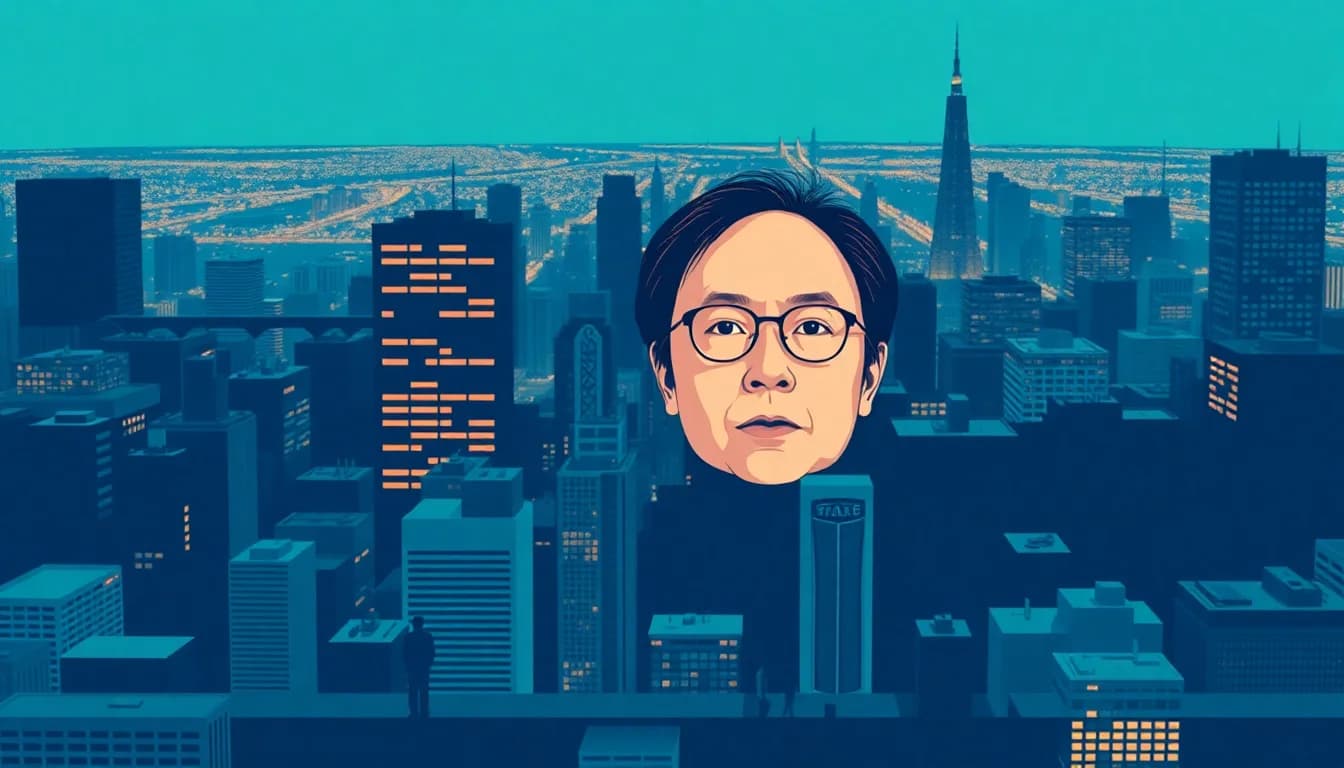
Byung-Chul Han, a German philosopher of Korean descent, was born in Seoul and has taught philosophy, media theory, and cultural studies in Basel, Karlsruhe, and Berlin. He gained recognition with his book "The Burnout Society," published in German in 2010, which discusses individuals who perceive themselves as free yet push themselves to exhaustion.
Han is known for his concise books, and for this article, we will focus on two of them: "The Burnout Society" and "Infocracy." These works will help us explore how voluntary activity can morph into a form of control and the importance of learning to stop.
You Can — Therefore, You Must
In "The Burnout Society," Han draws on the ideas of French philosopher Michel Foucault. In Foucault's 1975 book "Discipline and Punish," he describes a disciplinary society that governs individuals through prohibitions, routines, and surveillance, with prisons, barracks, and factories as its primary spaces.
According to Han, this model no longer accurately reflects contemporary society, which he terms the achievement society. This new environment encourages action through projects, initiatives, and motivation, promoting the idea that one can work more efficiently and accomplish more. Individuals raise their own expectations, viewing the burden of work as a pathway to success.
A 2026 study published in the Harvard Business Review highlighted a similar trend in a U.S. tech company, where employees began working longer hours and taking on additional tasks, often without being asked, as AI was integrated into routine processes.
Han attributes this shift to the desire for increased productivity. While discipline remains, the promise of new opportunities enables individuals to extract more from themselves than mere prohibitions would allow.
"The exploiter is simultaneously the exploited. The predator and the prey can no longer be distinguished," writes the philosopher.
Han links this relentless increase in activity to an excess of positivity, characterized by a constant drive to "can," with new opportunities and incentives for action. On the other hand, negativity involves prohibitions, resistance, and the right to interrupt the status quo. This negativity can both limit individuals and empower them to reject imposed actions.
In a society that does not acknowledge limits, failure becomes a source of self-blame: not trying hard enough, or not working on oneself enough. Han argues that this personal experience is underpinned by external pressure to achieve.
Attention Without Pause
The demand for greater productivity manifests in the everyday need to constantly switch between tasks. Han likens such individuals to wild animals, who must eat, care for their young, fend off competitors, and remain vigilant against potential threats.
"Multitasking is indeed widespread among wild animals. It is a method of managing attention necessary for survival in the wild," notes the philosopher.
This broad yet shallow attention helps individuals identify threats but leaves little room for focus. Han connects the development of culture to the ability to sustain attention on a subject, endure boredom, and allow thoughts to develop over time.
He borrows from German philosopher Friedrich Nietzsche the idea of training one’s gaze: learning to observe requires cultivating patience. Without the ability to delay reaction, hyperactivity turns into passivity, where individuals react to every stimulus.
Only Users Are Transparent
In "Infocracy," Han describes voluntary activity as a source of data. He refers to a form of power that utilizes information about individuals, algorithms, and AI to predict and manage behavior as the informational regime.
This type of surveillance relies on communication: the more a person reveals about themselves, the more detailed their behavioral profile becomes. Users may feel free, unaware of the ongoing observation.
"Dominance is completed when freedom and surveillance become one," writes Han.
He illustrates this asymmetry with the transparent glass cube of the Apple Store in New York. While the transparent architecture suggests openness, the mechanisms of power remain hidden. The user is visible, but the processes that handle their data function like a black box.
Apple Store on Fifth Avenue. Source: Apple.According to Han, surveillance blends into everyday life, concealed behind the convenience of search engines, voice assistants, and smart homes. Control becomes harder to detect when it arrives alongside desirable services.
A Crisis of Dialogue
Continuous communication does not necessarily foster mutual understanding. Following German philosopher Jürgen Habermas, Han views discourse as an exchange of arguments open to critique. Participants acknowledge their own errors and are willing to revise their opinions.
Problems arise when conviction merges with identity; dissent is then perceived as an attack on the individual or their group. Defending one’s belonging takes precedence over evaluating arguments.
Han critiques the theory of the "filter bubble" by American journalist Eli Pariser, which links users' information isolation to the algorithmic personalization of the internet. According to Han, people become entrenched in their beliefs, even outside of the online sphere.
The "digital tribes" he describes may encounter facts that contradict their beliefs but reject them to maintain a cohesive worldview. Thus, merely reconfiguring recommendation algorithms is insufficient to restore dialogue.
Consider a cryptocurrency community where questioning a project is seen as betrayal. Participants identify so closely with the project that they interpret criticism as a personal attack. Instead of discussing the technology's pros and cons, they defend their group identity. This attitude toward Bitcoin in 2023 was highlighted by Nick Carter, who criticized part of its community:
"There are those who use Bitcoin, known as Bitcoiners (the majority), and then there are people who have turned Bitcoin into a secular cult. Let’s call the latter laser-eyed maxis or something else; it doesn’t matter. They know who they are, and we know who they are. There is no ambiguity—these are people who have transformed Bitcoin from a tool into a belief system and way of life."
Dataists
The crisis of dialogue raises the question: how can we make collective decisions if people stop listening to one another? One proposed solution is to replace discussion with data processing. Han refers to proponents of this approach as dataists.
He explains that they perceive society as too complex for human reasoning. Big data and AI should uncover solutions unavailable to participants in a dispute.
Han quotes researcher Alex Pentland from the Massachusetts Institute of Technology. In his book "Social Physics," Pentland discusses the "divine ocean": a comprehensive view of society that could potentially enable understanding and addressing its challenges.
Han argues against substituting argumentation with computation:
"Artificial intelligence does not justify; it computes. Instead of arguments, there are algorithms," he writes in "Infocracy."
Han characterizes the dataist claim to complete knowledge as "totalitarianism without ideology." In his outlined perspective, managing a system based on data displaces political choice. Ideology promised to explain the past and predict the future, while dataism fails to explain anything; it merely computes.
A Day of Nothingness
"The Burnout Society" advocates for reclaiming the ability to manage one’s attention. Han distinguishes between two types of potential: positive (the ability to do something) and negative (the ability not to do something). It is vital to differentiate the latter from helplessness: an exhausted person can no longer act, while one who can stop maintains the choice.
Following Austrian writer Peter Handke, Han distinguishes between two types of fatigue. Alienating fatigue confines a person to themselves and diminishes their ability to communicate. Fundamental fatigue, on the other hand, weakens the focus on one’s "self" and opens attention to the world.
The image of such a state is the Sabbath, a day of cessation from labor. Han’s "day of nothingness" is free from the obligation to justify every activity by its outcome. The value of rest no longer reduces to preparing for the next work sprint.
Information Moves Faster Than Truth
Han identifies a crisis where the distinction between truth and falsehood no longer concerns people. Information is valued for the reaction it provokes or for what it confirms about existing beliefs. Verification requires time, while the news cycle constantly shifts attention to the new.
For Han, truth encompasses more than the accuracy of individual messages. He connects it to a coherent narrative that provides people with a common grounding for understanding the world. Accumulating information alone does not create such a foundation.
However, the coherence of a narrative does not guarantee its truth. Han illustrates this with conspiracy theories, which can provide a sense of meaning and belonging while remaining impervious to factual verification.
Following Foucault, the philosopher reflects on parrhesia—the courage to speak the truth while accepting associated risks. This kind of speech implies concern for society and limits arbitrary power.
Yet, in the conclusion of "Infocracy," Han reveals the limits of such speech. In a power structure built on lies, truth can challenge it. However, where the distinction between truth and falsehood has lost significance, even bold statements get lost in the information noise.
Text: Sasha Kosovan