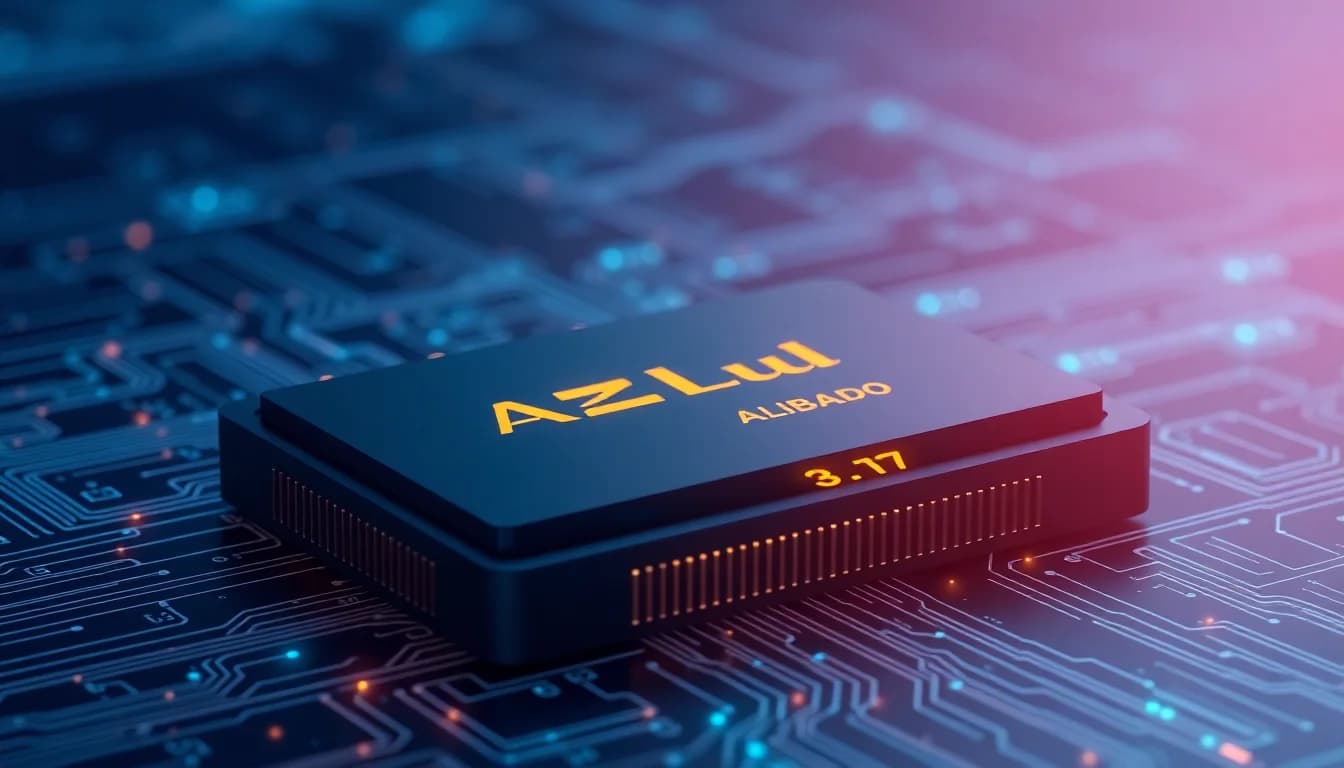
Chinese tech giant Alibaba has introduced the Zhenwu V900 AI accelerator, developed by its T-Head division. According to the company’s announcement, this new chip boasts three times the performance of its predecessor, the M890, which was released in May.
The Zhenwu V900 is designed for training and inference of large language models (LLMs) and is equipped with 216 GB of memory, an inter-chip connection with a bandwidth of 1200 GB/s, and supports computing in FP8 and FP4 formats.
Alibaba plans to begin mass production and commercial rollout of the accelerator in the first quarter of 2027.
The company also unveiled a new server supernode based on the V900. These systems can be clustered into groups of up to 500,000 chips for training and deploying large AI models.
According to Alibaba’s data, over 650 external clients from more than 20 industries are using Zhenwu-based solutions via Alibaba Cloud.
Alibaba Plans Models with Up to 10 Trillion Parameters
The new accelerators will be integrated into Alibaba's broader AI infrastructure. The company is currently training Qwen 4 and plans to scale subsequent versions, Qwen 4.5 and Qwen 5, to between 5 and 10 trillion parameters.
In comparison, the flagship Qwen 3.8-Max currently has 2.4 trillion parameters, meaning future iterations could be two to four times larger.
Alibaba's CEO, Eddie Wu, stated that future models should be better equipped to handle complex tasks requiring long-term planning. The company views this as part of its journey toward artificial superintelligence.
Moreover, Alibaba is experimenting with self-learning capabilities, allowing models to identify weaknesses, conduct experiments, and generate data for subsequent training sessions.
In one test, the Qwen 3.8-Max underwent 33 automatic improvement cycles within a month.
In a separate chip design experiment, the model worked for over 60 hours refining a solution and made more than 10,000 calls to electronic design automation (EDA) tools.
Alibaba reported that the final block's area was reduced by 42% without sacrificing performance.
Data Center Capacity to Exceed 20 GW
To support the new models and accelerators, Alibaba plans a significant expansion of its cloud infrastructure. By 2032, the total capacity of Alibaba Cloud’s data centers is expected to exceed 20 GW.
Wu noted that demand for AI is growing faster than the company can provide computational resources, with supply chain issues also hindering expansion. Alibaba Cloud is set to begin the commercial rollout of AI supernodes in the current quarter.
The company’s development of its processors comes amidst U.S. restrictions on the supply of advanced Nvidia accelerators to China, prompting local tech firms to seek alternatives.
In August, Alibaba raised $10.2 billion to bolster its AI initiatives, directing the funds towards computational infrastructure, proprietary chips, models, and applications.