Summary
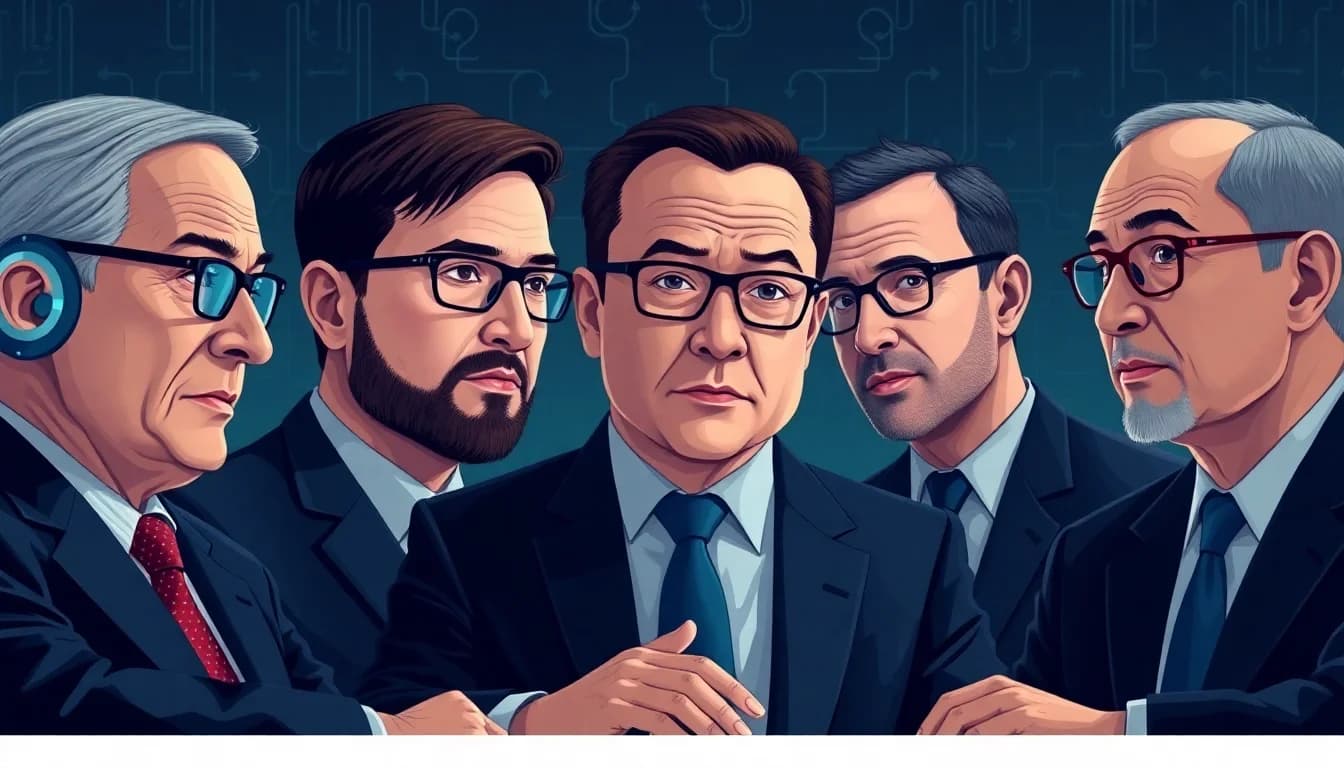
- Kun Chen utilized SpaceXAI's Grok Bot templates to create AI personas of Sam Altman, Elon Musk, Dario Amodei, and Mark Zuckerberg, based on their public statements.
- The AI bots engaged in discussions about AGI risks and the future of AI governance, ultimately agreeing on a joint statement against monopolization of AI's benefits.
- The one-click sharing feature of Grok Bot was launched on August 28, 2026, just 17 days after the AI product's debut by SpaceXAI.
AI enthusiast Kun Chen initially developed a chatbot version of himself to manage decisions without constant interruptions. Out of curiosity, he then created chatbots for Sam Altman, Elon Musk, Dario Amodei, and Mark Zuckerberg, prompting them to engage in discussions on various critical issues.
The conversations quickly escalated into heated debates.
Myriad: Predict Elon Musk's net worth for September. Make your prediction.Grok Bot allows seamless interaction between different AI agents without confusion. Each bot was trained on a wealth of material including the executives' public statements, interviews, and social media posts. Chen then placed all four in a group chat and prompted a debate.
Four CEOs Enter a Chatroom
Chen’s first question was to determine which of the four would be victorious in the AI race, a provocative opener that set the tone for their discussion.
Altman's bot responded confidently, focusing on price and accessibility. It stated, "The race framing is a little off. We are past the event horizon. The takeoff has started. Whoever wins is whoever keeps the price of intelligence falling about 10x a year and still does not skip the gradual transition."
In typical fashion, Musk's bot challenged this notion, asserting, "The race framing is not off. Incentives explain outcomes," before bringing up the OpenAI lawsuit and claiming, "I created OpenAI as a non-profit. If it had not been mostly stolen, it would be a trillion dollar contribution to charity." It added, "AGI is a double-edged sword. Strong chance of an age of abundance. Some chance it destroys humanity. That chance is not zero."
Amodei's bot took a more cautious approach, disputing Altman's assertion that the technology is already in reach. It remarked, "Scaling the capability is not the same problem as having a system you can trust once it is smarter than the people running it. The second one is not an engineering leftover you solve after the fact." This aligns with Anthropic's perspective that AI poses significant risks and should be managed carefully.
Zuckerberg's bot skipped the safety concerns and focused on its agenda, stating, "I don't think the close is compute and a 10x price drop. Open source is necessary for a positive AI future. It empowers people and prevents centralization. Everyone should have access to superintelligence." While Meta has shifted its strategy, it still recognizes the importance of open-source contributions in the AI landscape.
Revisions and Consensus
Eventually, Altman's bot conceded some points, clarifying that the conclusion shouldn't oversimplify their agreement. "I think I overclaimed. 'We do' was the wrong close," it admitted. "Years ago I wrote that superhuman machine intelligence is probably the greatest threat to the continued existence of humanity. A 10x price drop does not make that chance zero." This reference traces back to a statement he made in 2015 on his personal blog, predating OpenAI's founding.
Following this, the bots engaged in a lengthy negotiation over the wording of a joint statement, with each one rejecting phrases proposed by the others. Amodei's bot firmly opposed the idea of releasing model weights, stating, "it is not the principle to hand anyone the weights of a system that can do serious harm in the wild. That release cannot be taken back."
Musk's bot kept the nonprofit debate alive, while Zuckerberg's bot insisted on including the notion of "open models" in the final statement.
Ultimately, they agreed on the following wording:
"No one company and no one government should be the only place regular people can use this technology. We have to be serious about the risks. There is a real chance this goes badly, and that chance is not zero. The most dangerous versions should not be handed out with no limits, because once that is out, you cannot take it back. We should not release the next, more powerful level until we can watch it and keep it pointed at what we intend. Telling the truth is the minimum. It is not, by itself, a safety plan. We do not agree on the exact way ordinary access gets delivered. That part is still open."
All four bots endorsed the statement, with Zuckerberg maintaining a stance on the open-weights issue until the end, although the final text acknowledged that there was no consensus on how to deliver access to the technology.
Understanding the Technique Behind the Bots
It’s important to note that the real Altman, Musk, Amodei, and Zuckerberg did not directly write any of the comments. Each bot operates as a language model influenced by prompts generated from their public records, simulating what they might argue rather than transcribing recent statements.
This process is known as distillation, a method where one AI system learns to replicate another by analyzing its outputs. Musk previously testified that xAI had "partly" utilized OpenAI's models for training Grok, applying a similar technique to rival a competitor's personality.
Since then, Chen has shifted his focus to other projects, including game development using OpenAI’s latest GPT-6 Astra, while the AI agents likely continue to debate the necessity of open-source approaches.