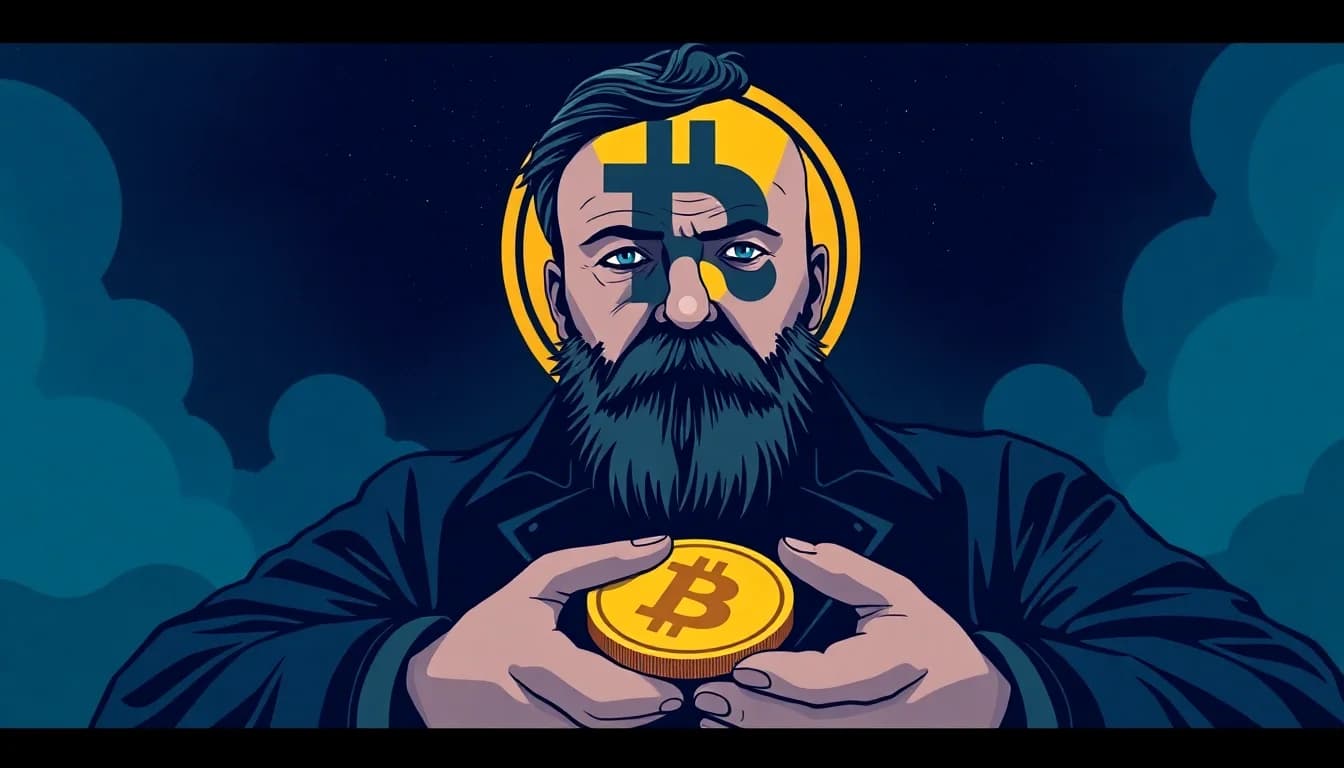
In this episode of "Deconstruction," we welcome Vadim Volkov, rector of the European University in St. Petersburg, sociologist, and author of the book "Anarchy, or Life Without a Boss."
We discussed the origins of anarchism, the ideas of abolishing the state and building a more just society, and how the views of classical theorists have influenced modern technologies: blockchain, cryptocurrencies, and DAOs.
ForkLog (FL): How has the concept of "anarchy" changed over time?
Vadim Volkov (V. V.): Since ancient Greece, anarchy politically signified a threat to the polis and an inability to govern it. This fear persisted until the mid-19th century, when an intellectual innovation occurred.
Pierre-Joseph Proudhon and other anarchists proposed stepping out of this political sandbox. They sought to operate without the state and build society through direct connections.
During the industrial revolution and scientific advancements, the old order was collapsing. In this context, a new state emerged, along with many new utopias, including anarchist thought.
FL: What is Proudhon's concept of the exchange economy and social contract?
V. V.: His ideas on the exchange economy were rather weak. He suggested small communities where people engage in direct exchange without added value, interest, or rent.
The social contract became an empirically consistent expression of this exchange theory. It was a real voluntary agreement among all to establish the principles of society.
Each person agrees with every other to create a community for specific economic, political, or cultural purposes. Thus, through voluntary connections, everything operates without any central authority.
FL: When did the state gain a monopoly on legitimate violence?
V. V.: This occurred roughly a hundred years after the Thirty Years' War from 1618 to 1648. The state became the sole monopolistic form of political organization in modern times.
We now consider this order part of the familiar landscape or natural state. Although anarchists proposed their concept, claiming that the natural state is mutual aid.
They argued that inherent human qualities would flourish if the state were simply removed. However, this was a weak concept, as it assumed a certain immutable and benevolent human nature.
FL: Why has rebellion become the domain of individuals?
V. V.: If direct action leads to seizing power, then political prizes become very toxic. The state apparatus and hierarchical governance quickly co-opt those who obtain them.
Political action cannot be symmetrical, leading to the brilliant question: how to change the world without seizing power? Lifestyle anarchism attempted to address this by preserving inner freedom, spontaneity of thought, and creativity.
This resulted in a retreat into creative communes and individual projects, effectively burying the political agenda. The recipe emerged from the painful experience of understanding that power subjugates the individual to its logic.
FL: How do you assess Balaji Srinivasan's Network State project?
V. V.: Any social experiments and innovations seem better than merely reproducing existing systems. However, in this project, the term "state" is misused.
The state represents a territorial monopoly on violence, taxation, and law-making. These distributed communities are better described as attempts to build networked social forms within the state's framework.
Balaji's initiative is very correct, but it already presupposes a selection of people socialized into these ideas. As long as they are harmless and do not compete with states, they will be viewed as exotic.
FL: Can order exist without personal trust?
V. V.: Order can indeed exist where people fundamentally do not wish to know each other. Modern megacities serve as excellent examples of more complex forms of social control, where trust operates without personal acquaintance.
Crypto-anarchism grew from the idea of minimizing trust and creating smart contracts. The latter act as a third party that verifies compliance with conditions and executes itself.
However, there is no direct continuity with classical anarchism, as humanism has completely disappeared. In this system, the individual is absent, replaced by algorithms and programming code.
FL: Why haven't cryptocurrencies led to anarchism?
V. V.: Early anarchists fought against the state but failed to create a reliable infrastructure for decentralized communities. Crypto-anarchists developed such a technological base in the form of blockchain and consensus algorithms.
They believed that creating infrastructure would immediately solve the problem, but that was just the first step. The next question is the acceptance of this technology by the majority, but that large-scale transition has not occurred.
Society does not quickly adopt new tools, and any technology is neutral in itself. Its real meaning is defined by its use, which can be very far from the original intent of its creators.
FL: What is more important for a crypto project: the right to vote or the right to exit?
V. V.: From a conservative perspective, the internal ethical commitment of the participant takes precedence. This voluntary obligation to participate in the collective project until the end, without exiting or deceiving, is crucial.
If everyone has the right to exit at any moment, participants will want to take advantage of this before others for their own benefit. In such a case, long-term expectations collapse, and the entire social structure quickly disintegrates.
Therefore, the right to exit should be placed last. A true human community relies on ethics, not on attempts to fully algorithmize social connections.
FL: Would the classics of anarchism recognize the ideas of crypto-anarchists?
V. V.: Social anarchists were consistent anti-capitalists seeking a lost paradise in the distant past. Each theorist had their own ideal: from early Christians to primitive stateless communities.
This entire line denies not only the state but also the market, competition, inequality, and money. Therefore, anything related to techno-optimism and financial markets would not resonate with them.
Proudhon, Bakunin, and Kropotkin would hardly recognize their ideas in blockchain. The connection between their works and cryptocurrencies is too mediated.
FL: What does blockchain need for mass adoption?
V. V.: Currently, there is a lack of intermediary technological links between blockchain systems and the mass user. Industries need user-friendly interfaces, devices, and entire layers that can bridge complex technology to ordinary people.
Whoever invents these intermediary tools will successfully address the main scalability issue. If independent engineers achieve this, they can facilitate a synchronous and non-conflictual change in society.
This approach would effectively place the state out of the game. However, if the creators of crypto projects fail, the initiative will be seized by the state itself, which will adapt the ideas to its own goals.
The conversation has been significantly shortened. Watch the full episode:
https://www.youtube.com/watch?v=lsTUAR3m6UE
Subscribe to the podcast: