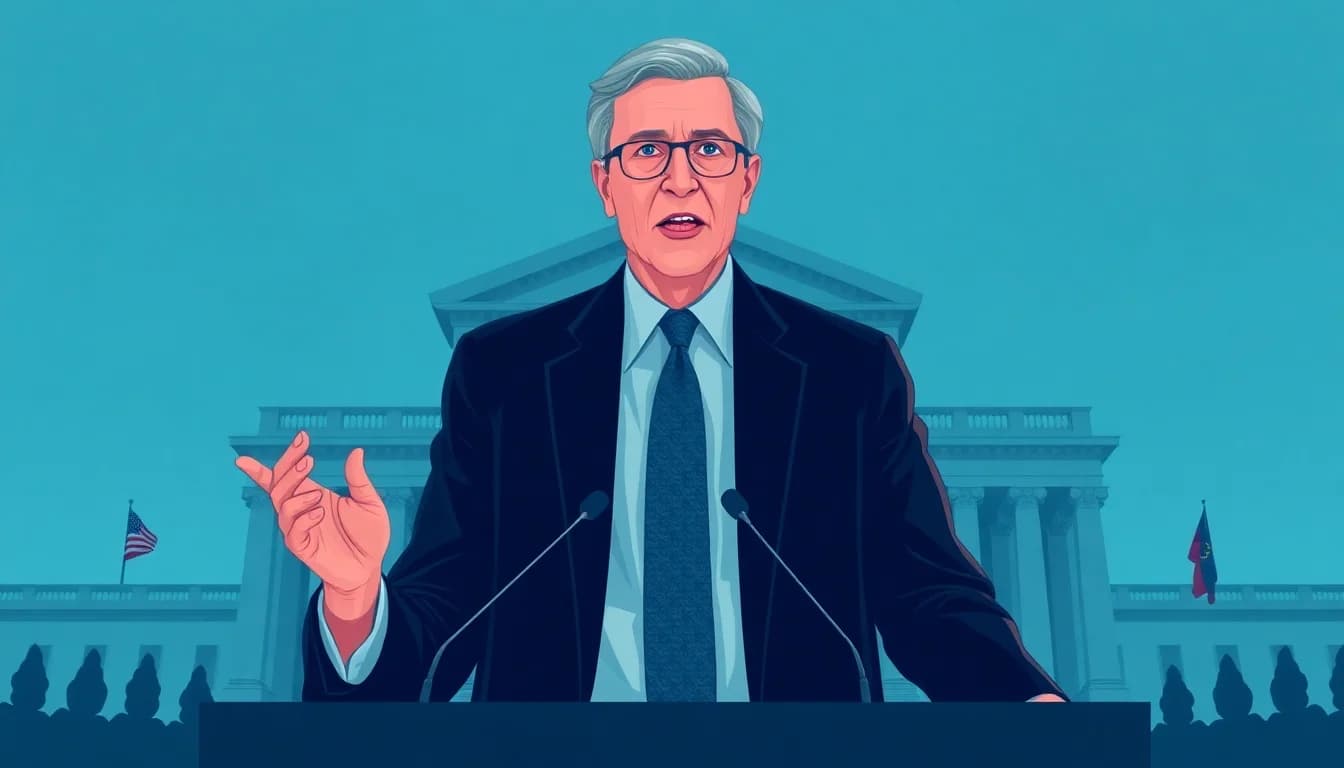
On July 30, U.S. Treasury Secretary Scott Bessent called on the Senate to vote on the CLARITY Act immediately, accusing Democrats of delaying the process for political reasons.
More than a year ago, the House passed the Clarity Act.
There’s been progress since — thousands of hours of bipartisan negotiations took place at the staff and Member levels. The Senate Committees on Banking and Agriculture advanced their respective titles. And Senate…
— Treasury Secretary Scott Bessent (@SecScottBessent) July 30, 2026
Bessent reminded that the House approved the bill over a year ago. He noted that since then, Senate Banking and Agriculture committee staff have invested "thousands of hours in bipartisan negotiations." He stated that Republicans have a version ready for a vote, which only awaits Senate action.
Concluding his address, the Secretary referenced a quote from Bitcoin's creator, Satoshi Nakamoto:
“America will either lead or not. It’s that simple. In such moments, I always remember Satoshi, who once said: ‘If you don’t believe me or don’t understand, I don’t have time to convince you, sorry.’”
Bessent also dismissed criticisms that the CLARITY Act inadequately protects consumers and fails to close loopholes for illegal financial activities. He asserted that Sections II and III significantly enhance requirements for intermediaries in the digital asset market, aligning them more closely with standards for traditional financial institutions.
Furthermore, he defended the Blockchain Regulatory Certainty Act, a provision of the bill that protects decentralized software developers. This provision reinforces the Treasury's long-standing position that developers are not required to register under the Bank Secrecy Act. Bessent added that the Brotherhood of Police, which previously opposed this provision, now supports it.
According to the Treasury Secretary, Democratic senators are hesitant to proceed with the vote due to concerns about the reaction from Elizabeth Warren and her "anti-cryptocurrency army."
Reasons for the Bill's Stalemate in the Senate
The main obstacle lies in the ethics section. Democrats oppose the current version due to provisions regarding conflicts of interest related to President Donald Trump. On July 20, the White House approved a package of ethical provisions and shared them with some Republican senators — this discussion occurred during a meeting between the President and Cynthia Lummis, Bernie Moreno, Thom Tillis, and Bill Hagerty, excluding Democrats.
The final version of the bill prohibits the President, Vice President, members of Congress, federal judges, and other government officials, along with their spouses, from issuing or sponsoring digital assets for compensation. This provision is effective until January 20, 2029, with enforcement overseen by the Department of Justice. Officials' existing crypto assets must either be sold or placed in a blind trust.
Democrats have expressed dissatisfaction with this proposed structure. Senator Angela Olshbrooks criticized the reliance on the Department of Justice for enforcement as insufficient, while Ruben Gallego told Politico that Republicans have reduced months of negotiations to a text far from consensus.
On July 14, three other senators also opposed the bill. Their primary concerns included the limited duration of the measure, the singular enforcement channel, and the lack of prohibitions for officials' children.
Opposition is not limited to Democrats in Congress. On July 28, New York Attorney General Letitia James stated that transferring oversight of the digital asset market to the CFTC would weaken states' authority to investigate fraud and urged the preservation of existing state laws.
The situation in the Senate is not favorable for Republicans, who hold 53 seats, while 60 votes are needed to overcome procedural hurdles. On May 14, the banking committee approved its version (15-9) and forwarded it to the House for consideration.
On July 23, Majority Leader John Thune acknowledged that he does not expect the bill to be passed before the recess but hopes to at least start discussions. The recess is set to begin on August 7, after which lawmakers will focus on the upcoming midterm elections.
JPMorgan's Assessment
JPMorgan analysts believe that diminishing prospects for the passage of the CLARITY Act could negatively impact the cryptocurrency market, as reported by CoinDesk. They referenced prediction markets, which estimate the likelihood of approval by the end of 2026 at approximately 31%.
Clarity Act (H.R.3633) signed into law in 2026?Yes 31% · No 69%
View full market & trade on Polymarket
The longer the decision is delayed, the greater the likelihood that developments in tokenization and blockchain applications will fall under the control of traditional financial structures rather than remaining within public crypto networks. The enactment of the law could pave the way for institutional investments, increase trading volumes on regulated U.S. exchanges, and simplify market access for banks, exchanges, custodians, and market makers.
Experts have noted some positive signals already, such as Citadel Securities' $400 million investment in Crypto.com and the approval of the first regulated perpetual cryptocurrency futures in the U.S. However, the current draft of the CLARITY Act may deter institutional investors, as it removes certain operations involving tokenized securities and derivatives from SEC and CFTC oversight. Additionally, the anti-money laundering requirements within the bill are less stringent than those for traditional financial firms.
It is worth mentioning that in late May, JPMorgan CEO Jamie Dimon criticized the bill due to its provisions regarding stablecoin rewards.