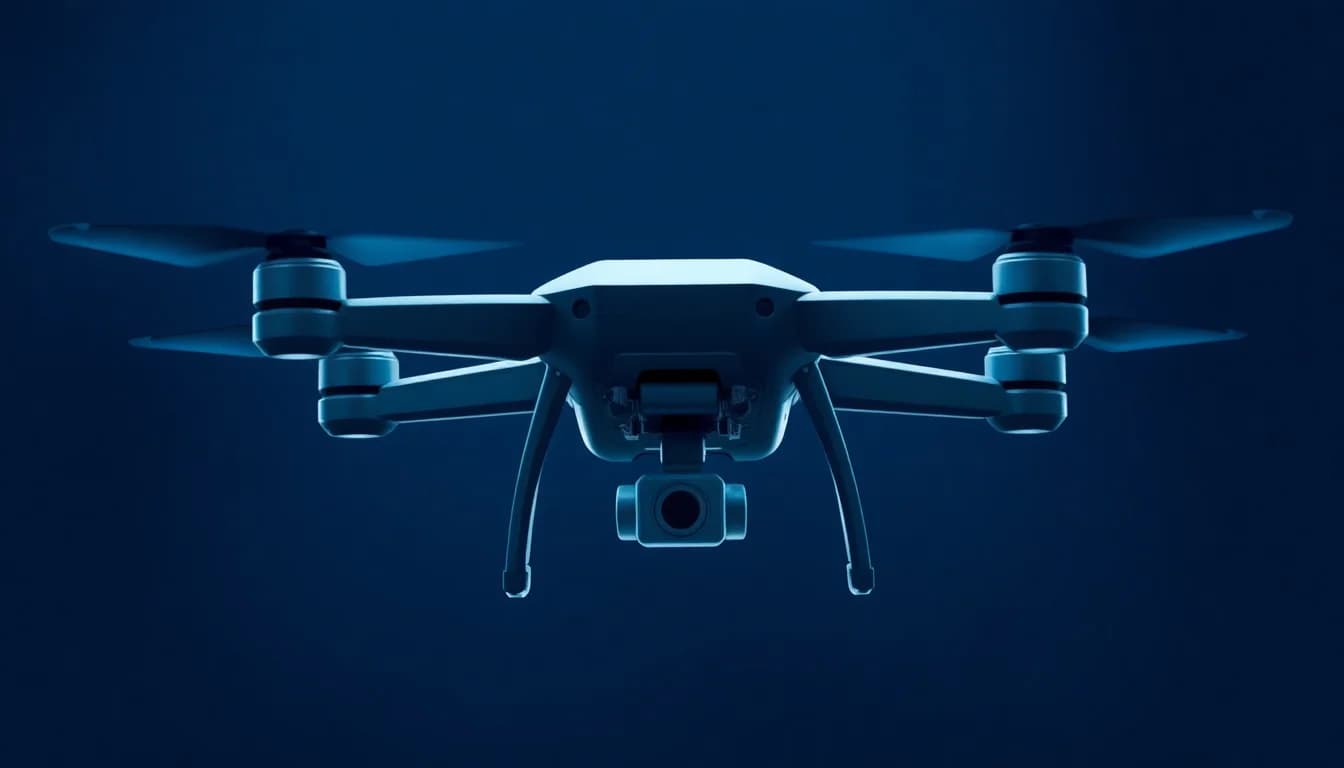
Beginning September 3, the United States will implement additional tariffs of 25% and 100% on specific categories of imported drones and their components. Sources speaking to TechCrunch believe these restrictions may not lead to a complete separation between American and Chinese robotics industries but could instead increase regional market fragmentation.
On August 13, President Donald Trump signed the relevant document. According to the text, the 100% tariff will apply to drones weighing over 25 kg, those equipped with thermal imaging systems, docking stations, and various components unless they qualify for an exemption.
Drones weighing up to 25 kg without thermal cameras will incur a 25% tariff.
Starting February 9, 2027, the 25% tariff will also extend to additional components, including propellers, rotors, and chassis imported for use in drones.
For products from the EU, Japan, South Korea, Taiwan, Switzerland, and Liechtenstein, a cumulative tariff cap of 15% is set, while the UK will have a cap of 10%. The exemption applies if the importer can confirm that nearly all critical components and technologies originate from the U.S. or the listed countries.
For companies whose products were included in the Blue UAS Cleared List, Blue UAS Framework, or the conditional approval list as of September 2, the implementation of the new tariffs will be postponed for 180 days. Additionally, companies with an approved localization plan for production in the U.S. will also be able to temporarily import necessary products without incurring extra tariffs.
The proclamation cites national security risks and the U.S. industry’s dependency on foreign supply chains as reasons for these measures.
China Maintains Production Scale Advantage
While the restrictions may offer some protection to the American market, they do not directly eliminate China’s advantage in terms of production scale and cost, according to sources from TechCrunch.
As reported by Counterpoint Research, global shipments of humanoid robots exceeded 22,000 units in the first half of 2026, marking a nearly 300% year-over-year increase.
The five largest manufacturers — AGIBOT, Unitree, Galbot, UBTECH, and Leju Robotics — are all Chinese companies, collectively accounting for 86% of global shipments.
Investment director at TDK Ventures, Ankur Saxena, highlighted the differing competitive advantages between the two countries:
“The U.S. excels in advanced AI, software, and semiconductor innovations, while China leads in production scale, supply chain depth, and cost.”
He noted that lower prices enable Chinese manufacturers to rapidly increase their fleet of operational robots, providing them with more real-world usage data, which further reduces costs through higher production volumes.
Lead analyst at Counterpoint Research, Soumen Mandal, also pointed out the expansion of component development by Chinese companies and their ability to leverage the established industrial base in the country.
Chinese Manufacturers Target Other Regions
Even with reduced access to the U.S. market, Chinese manufacturers still have a large domestic market and opportunities for expansion into other countries. Mandal stated that companies are already focusing on price-sensitive markets with labor shortages in Europe, Southeast Asia, Latin America, and the Middle East.
He anticipates a scenario similar to the evolution of the Chinese automotive industry: scaling up domestically, entering foreign markets, and then localizing production.
A key source of demand may arise from countries facing labor shortages and aging populations, particularly in industries where humanoid robots can perform repetitive tasks.
Drones Illustrate Potential Market Division Scenario
Ben Tsion Levinson, founder of American drone manufacturer Heven AeroTech, believes the drone market is an early example of how robotics may evolve overall. He assesses that two distinct models are already emerging:
- the American model, which places greater emphasis on equipment origin and safety requirements;
- the Chinese model, focused on mass production and lower costs.
Levinson argues that Western companies will find it challenging to compete with Chinese manufacturers in the low-cost consumer segment. Instead, they may concentrate on long-range autonomous systems for defense and critical infrastructure.
He identified power systems and payload architecture as the next competitive areas, noting that as drone capabilities grow, battery limitations become increasingly significant.
Multiple Markets May Emerge Instead of Two
Sources from TechCrunch do not foresee a complete division of the industry into American and Chinese ecosystems.
Saxena believes a more realistic outcome is the creation of a diversified supply chain involving U.S. allies. Japan has expertise in industrial robotics and precision manufacturing, South Korea in electronics, batteries, and automotive production, while Taiwan specializes in semiconductors.
However, these countries cannot fully replace China due to the deep integration of Chinese components into global supply chains.
As a result, several regional markets may develop: Chinese companies will continue to compete on price and scale, while American and allied producers will focus on segments with heightened safety requirements, and firms from Japan, South Korea, and Taiwan will aim to occupy an intermediate niche.
It is worth noting that on July 28, the U.S. Federal Communications Commission included advanced foreign robotic devices in the Covered List, providing exceptions for products with conditional approval from authorities.