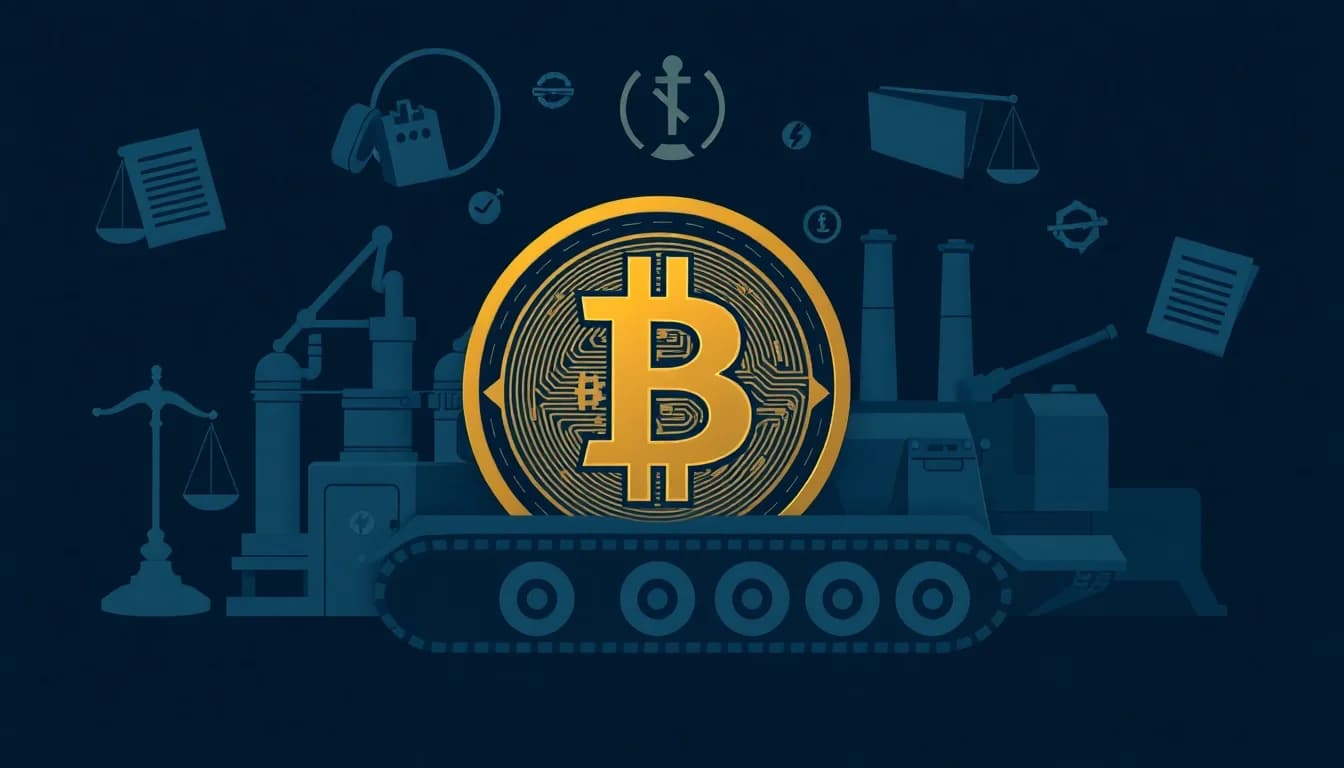
When RWAs Face the Pressures of the Real World
What if tomorrow an oil rig divided into a thousand tokens is seized by an army or declared property of a state?
With this question in mind, ForkLog looked beyond the curtain of tokenization of real-world assets and saw a chasm between the rising value of the RWA segment, its benefits, convenience, and guarantees.
A Challenge for Lawmakers
RWAs are undoubtedly an intriguing and groundbreaking segment. Tokenization of real-world items allows for 24/7 tracking of the current state of an asset or business, giving retail investors access to previously closed resources, energy, and stock trading on the blockchain.
For TradFi representatives, RWAs offer new liquidity streams from retail, the ability to sell expensive illiquid assets, and acquire more valuable objects. Moreover, the crypto derivatives market provides new rails for old financial instruments and can accommodate real-world assets within perpetual futures contracts, not to mention the variety of DeFi mechanics.
However, amidst the clear advantages of tokenizing real-world assets, the downside can easily be overlooked.
Given the escalating tensions in the world and increasing uncertainty in superpower politics, the risks of owners losing control over RWAs are high. History has seen numerous attempts at devaluation and nationalization of property:
- British enclosures (15th-19th centuries). The process of converting communal lands into private property. Lords fenced off pastures, depriving peasants of access to resources. This led to increased productivity (wool for factories) but ultimately created an army of impoverished proletarians;
- railroad mania (1840s). In 1845, Britain experienced a boom: hundreds of companies offered to build railroads through stock issuance. People invested their last savings in “paper” railroads. When the bubble burst, investors went bankrupt, but the physical tracks remained. Major banks bought them for pennies and created monopolies that profited for decades;
- post-Soviet privatization (1990s). The socialist structure of the USSR assumed collective ownership of material resources by all citizens. For instance, a factory worker owned a share of the enterprise he worked for. After the collapse of the Union, a collapse occurred: all privatized shares plummeted in value and were skillfully bought up by businessmen. Sometimes, factory directors created conditions that devalued vouchers, then invested in them through shell companies.
Another potentially dangerous vector for asset loss is military conflict. If a tank demolishes a support of a building partially owned by an investor, or an invader declares the territory as theirs, only the funds from insurance companies may provide assistance.
Insurance policies include categories for "political risks," but for crypto innovators, these exist only in theory for now.
The emergence of cryptocurrencies and blockchain has posed a new challenge for lawmakers. Major regulatory regimes in the US, EU, Singapore, and popular offshore jurisdictions have proposed their versions of corporate law and retail investor protection, relying on old acts. However, even these systems do not yet eliminate all legal and structural risks associated with the tokenization of real assets.
On-chain Risk Maps Are Insufficient
There are three popular models for the legal structuring of RWAs:
- SPV (shareholder or debt capital). The real asset is legally transferred so that the SPV becomes the sole owner. The investor owns a token that gives them a claim against the SPV;
- master fund. A central “master fund” is created to hold and manage the actual portfolio (e.g., US treasury bonds, corporate loans, or real estate). Small “feeder funds” or SPVs are registered in specific jurisdictions (e.g., one in the EU, one in the US). They issue digital tokens for sale to investors;
- claim-based token model. For the asset owner (e.g., a real estate developer or business owner), this form primarily functions as a financing tool. The asset remains on the balance sheet without the need to transfer ownership rights to third parties. The owner signs an agreement with the platform, committing to pay a portion of the income (rent, revenue, or interest) to token holders via smart contracts. Upon expiration or sale of the asset, the final value is paid, and obligations are canceled.
Source: AdamSmith.
According to the law firm AdamSmith, tokenized funds regulated by the EU typically opt for Luxembourg RAIF and Irish ICAV/QIAIF. For global capital outside the US, SPC structures in the Cayman Islands remain standard. For US-oriented projects, Delaware registration with low tax benefits is widely used.
Experts consider Switzerland, Germany, and Liechtenstein as leading centers for RWAs.
By 2026, the tokenization market is expected to mature further, but lawyers continue to tackle the issues of protection against political risks through complex legal schemes and contractual mechanisms. Some platforms utilize not only smart contracts but also guarantees from agencies insuring complex risks.
For instance, the market leader in RWAs, Ondo Finance, has US government debt and BlackRock ETFs as their underlying assets. In their case, aggressive “seizure” or nationalization of the real asset is unlikely and equated to the risk of a US default. By 2026, they expanded into equity markets, utilizing custodians like BNY Mellon, which have their own protective mechanisms.
Centrifuge, one of the oldest protocols, operates through an SPV structure. In the event of a physical seizure of an asset in the real world, their legal structure allows investors to sue in the jurisdiction of the SPV (usually Luxembourg or Delaware). Some of their lending pools in developing countries (through partners like Credix) can be insured by private PRI companies.
The insurer Goldfinch operates in high-risk regions: in developing markets in Africa and Latin America. Its borrowers (local financial companies) are often required to insure their portfolios against political risks with traditional insurance companies.
The leader in decentralized on-chain insurance, Nexus Mutual, has a rich track record. The company is managed by a DAO that decides on policy issuance. Platform participants invest in pools of interest to cover financing, receiving interest from the insurer's clients in return.
Cases include various types of on-chain risks: from smart contract hacks to technical failures of DeFi platforms and stablecoin de-pegging stablecoins.
Source: Nexus Mutual.
Insurance products are well-developed, but their coverage is limited to the “digital plane,” which is insufficient for the RWA segment. They do not address important aspects of the physical world—such as isolation or loss of the tokenized object.
In February 2026, Nexus Mutual, in partnership with crypto insurer OpenCover, launched the “On-chain Risk Map” project. This interactive scheme was intended to detail all possible obstacles for investors in cryptocurrency and related industries, but in practice, it turned out to be incomplete.
A fragment of the “On-chain Risk Map” detailing the risk of loss on the custodian's side. Source: The Onchain Risk Map.
Loss of material value falls under the risk section on the custodian's side—the asset holder. However, on the map, it is only represented as regulatory seizure, demonstrating the market leaders' unpreparedness for full PRI coverage.
Influential Investors, Cloud Cities, and Bans
An unexpected shift in the political course of a regulator in any country can instantly impact the fate of any RWA project. This happened with Satoshi Island, an island NFT state in Vanuatu.
Despite promises to settle the first residents by 2023, as of the time of writing, not a single house from the planned modular constructions has been built on the island. The only resident was one of the project leaders, Denis Troyak.
All these years, he developed a community of investors and showcased the benefits of existing away from civilization.
Watch our video & see how we're turning a dream into reality!
— Satoshi Island (@satoshiisland) January 27, 2022
Yes, we already own the island
Yes, we can develop as advertised
Yes, the government supports our plan
Yes, our team has relevant expertise
🏝️#satoshiisland a home for crypto enthusiasts & professionals worldwide! pic.twitter.com/1O05kmfrN1
It turned out that investors cannot own land directly. The island belongs to local landowners and is leased to the project. As a result, NFT buyers effectively receive only sublease rights, not full ownership rights.
Vanuatu regulators issued warnings back in 2024 that Satoshi Island Limited lacked a license for permanent residency or citizenship processing, although the project actively used this as a marketing ploy.
In July 2025, the team officially announced the suspension of operations for buying and selling all digital assets, effectively paralyzing the secondary NFT market.
As a result, the Satoshi Island Coin (STC) plummeted. As of February 24, 2026, its value had dropped by more than 99.9% from its historical peak (from $48 to ~$0.004).
Another illustrative case was not directly related to tokenized assets but vividly demonstrated the conflict between the crypto industry and outdated laws.
Investors in the city of Próspera in the economic zone on Roatan Island in Honduras suffered from a change in the country's political leadership. The project was established based on the ZEDE law (“Zones for Economic Development and Employment”), which granted investors unprecedented autonomy.
The government of President Xiomara Castro, which came to power under the slogans of fighting “corporate colonialism,” officially repealed the law. In September 2024, the Supreme Court of Honduras declared it unconstitutional.
In response, the developer company Honduras Próspera Inc. filed a lawsuit for $10.7 billion in international arbitration (ICSID) at the World Bank. Its representatives demanded compensation amounting to one-third of Honduras' GDP, citing that the contract guaranteed them legal regime stability for 50 years.
In 2024-2025, the Latin American republic began the process of exiting ICSID in protest to avoid paying possible rulings in favor of Próspera.
For investors in such a challenging situation, fighting the state would likely be impossible without a substantial list of capital guardians. Among the early participants of Pronomos Capital are billionaire Naval Ravikant, author of the Network State concept Balaji Srinivasan, and activist Patri Friedman, closely associated with Peter Thiel's fund.
Thanks to the founder of Palantir, the conflict likely attracted the attention of the US Congress to give the case international status and exert necessary pressure on the Honduran authorities.
Despite the lawsuits, Próspera continues to operate. With investors' funds, the tallest building on the island—Duna Residences—along with office and medical centers, has been constructed.
Source: Próspera.
Over 200 companies are actively involved in the community, creating around 1,000 jobs. Digital nomads, crypto entrepreneurs, and scientists reside there. Próspera has become known as a hub for biohacking and medical tourism. Thanks to liberal regulations, advanced methods of gene therapy and longevity, not yet approved in the US, are being tested there.
Srinivasan proposes solutions that could already reduce political risks for the RWA segment—an integral part of his vision of “network states.”
The main thread of his theory revolves around decentralization and the power of code over law. Although he acknowledges that the legal aspect remains the weakest link in creating “digital archipelagos.”
According to him, protection of RWAs in a “network state” should be ensured by dispersing assets across jurisdictions of different countries. If the authorities of one country attempt to confiscate a building, they cannot destroy the entire structure.
If, for example, it becomes possible to receive an insurance payout for a destroyed or expropriated object in one location, the community will build two new ones elsewhere.
All property becomes cryptography.
— Balaji (@balajis) July 27, 2025
Let me explain why.
(1) First, right now, trillions of dollars worth of digital gold is secured on-chain. Bitcoin is now valued everywhere there is an internet connection. And no matter what political faction you're in, everyone agrees on the… https://t.co/rwJ3MLMfxd
In a post from July 2025, “All property becomes cryptography,” Srinivasan described simple technical points that add difficulties for those wishing to seize assets.
For him, the development of RWAs represents a fundamental shift in the very nature of ownership. Srinivasan emphasizes that traditional property rights have always relied on violence (police and military), whereas cryptographic rights rely on mathematics.
“The ultimate goal is to make any form of property as difficult to confiscate as Bitcoin. We are moving from a world where property rights are enforced by the state to a world where they are enforced by knowledge of the private key,” the businessman believes.
Srinivasan is confident that the future lies with assets that cannot be “turned off” by a simple order from an official. This leads to the concept of “cryptographic locks” not only for data but also for physical items.
In conclusion, it can be stated that the RWA segment today exists in a “gray zone” of its evolution. On one hand, we have convenience and liquidity; on the other, the unresolved issue of the “last mile,” where blockchain meets the reality of kamikaze drones and nationalization.
Traditional legal tricks like SPVs and Luxembourg funds remain important crutches, but cases like Satoshi Island and Próspera show that even the most ambitious projects can become hostages of political regimes. Investors in RWAs need to consider not only the audit of smart contracts but also the macroeconomic landscape of the region.
The gap between the segment's growth and real guarantees remains significant. However, if Srinivasan's theory holds true, over time, the “seizure of an oil rig” will become meaningless if, without a cryptographic key, it turns into a pile of illiquid iron that cannot be legally sold or utilized in the global digital economy.