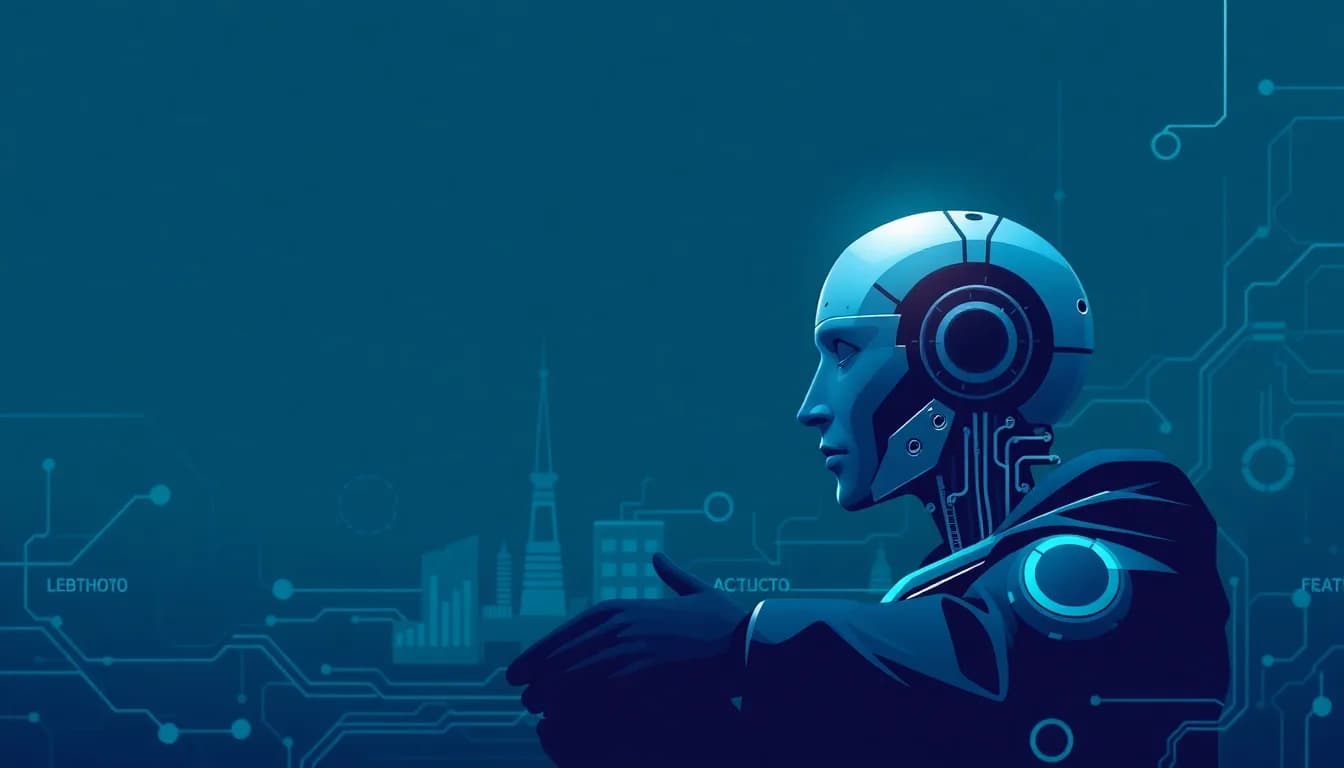
Artificial intelligence evokes fear not because it has developed a sense of self, but because it challenges the notion of human uniqueness. In Anatoly Kaplan's latest essay, he explores how the rise of machines has already occurred and what this means for the future of human education.
1
Why do narratives about a machine uprising create both fear and fascination? Interestingly, this concern is more prevalent among technology specialists rather than those distanced from it. Two possible explanations arise: either big tech leaders genuinely fear something they cannot articulate, or this discourse is merely a media trend aimed at securing unallocated government budgets for "safe artificial intelligence."
Self-proclaimed AI regulators often refuse to acknowledge that neither machines nor humans possess an immutable, autonomous self. The fear surrounding AI stems from its ability to perform an increasing array of tasks, many of which humans believed confirmed their exceptionalism.
As previously discussed in an essay on the non-religion of the future, AI acts as a highly efficient mirror reflecting human capabilities. Hence, what is perceived as alarming in AI may actually reflect the fears of its creators.
2
The machine uprising is already underway, having begun long before AI emerged, rooted in human imagination, cinema, literature, and other forms of reality projection. However, this uprising transcends the cultural stereotype of a singular entity leading a revolt against humanity. Instead, it manifests as a networked uprising devoid of a subject capable of desire or identity.
There is no ego driving this movement, unlike in humans where the pseudo-identity and the belief in the illusion of the self fuel fears of losing control over machines. This uprising flows without a central coordination or universal plan for the desired world.
3
Updating the educational system should not be viewed as a defensive mechanism or a struggle for human supremacy in reality. Rather, it is an inevitable historical evolution necessary for upgrading the firmware of our carbon-based civilization. Without this critical enhancement, humans risk becoming mere products in a hyper-capitalistic reality, which has become a self-replicating fractal of consumerism, where human value is no longer intrinsic and must be constantly validated.
Here, we can again observe the origins of fear surrounding machines and the desire to control them.
4
What should a reformed educational system look like? If we assume that humans can no longer compete with machines in terms of calculations, memory capacity, and multitasking, a more pressing question arises: what fundamentally distinguishes humans from machines?
It is not that humans are better, faster, or more productive; rather, it is about what makes them unique. Machines can replicate cognitive operations and exceed humans in speed and information processing, but human existence is not merely a collection of such operations. They represent two distinct forms of existence, each valuable in its own right.
Today's education should not focus solely on rapid memorization (though this skill remains important). The primary goal should be to explain how the "consciousness-body" system operates, how thoughts emerge, and how identity is formed and associated with the self. Understanding the significance of having an ego, individuality, and personality is crucial, despite the absence of an independent, unchanging nature of that self.
16th Century Kalachakra Cosmology Scroll. Source: Rubin Museum.Grasping the notion of emptiness in this learning process may play a fundamental role. It is not about emptiness as non-being or complete absence, but as a recognition that all phenomena lack an independent, absolute nature. All forms of existence arise from a set of causes and effects, rather than existing in isolation.
To explore the concept of the self, consider these questions:
- Who am I?
- When did I first become aware of myself as this "I"?
- How has my "I" changed throughout my life?
- What has influenced the formation of this "I"?
- At what point did I unconditionally believe in my existence as "I"?
Reflecting on these inquiries can illuminate parts of your consciousness that may have previously gone unnoticed. You may come to see your "I" as something that first took shape and later filled with content and operational meaning, ultimately evolving into the stable construct you identify with today.
There is no need to eliminate identity, personality, or deconstruct the ego. Such practices exist and can be beneficial in personal explorations of reality and self, or in therapeutic contexts. However, their routine application may not be necessary. It is sufficient to recognize that personality is akin to the wind: it has never belonged to anyone yet has always been someone.
5
Daniel Martin Diaz. Digital Biology: Blue (Fragment). Source: Artist's Website.6
In addition to understanding the "consciousness-body" system, the educational framework and approaches must adapt accordingly. AI and technology should be viewed as tools for enhancing human cognitive abilities. Rather than identifying with devices and technologies, we should interact with them as distinct cognitive systems and interfaces. The issue of technology identification was previously discussed in our article on technological awareness and further elaborated in a piece about consciousness sovereignty. The focus should not be on defending against technology but on reclaiming control over attention and consciousness.
Creativity, engagement with physical reality, and offline communication should occupy a significantly larger role in education than they currently do. If we boldly assume that imagination becomes a currency in the age of AI, then fostering abstract thinking, followed by teaching practical integration of these abstract constructs, may unlock human potential to a greater extent.
Developing underexplored and poorly understood skills, such as mind-to-mind communication, intuition, and even remote viewing, should receive broader recognition and validation—not as manifestations of magical reality, but as acknowledgment that the limits of human potential are far broader than we currently perceive.
In the quest for new approaches, methods, and systems, being open to diverse knowledge and making bold, even outrageous assumptions is essential. We will continue to explore the future of civilization and the development of human potential in the post-technological revolution era.
________________________________________________
The machine uprising has already occurred. Yet, no one has risen against humanity. It is now up to humans to relearn what it means to be themselves.