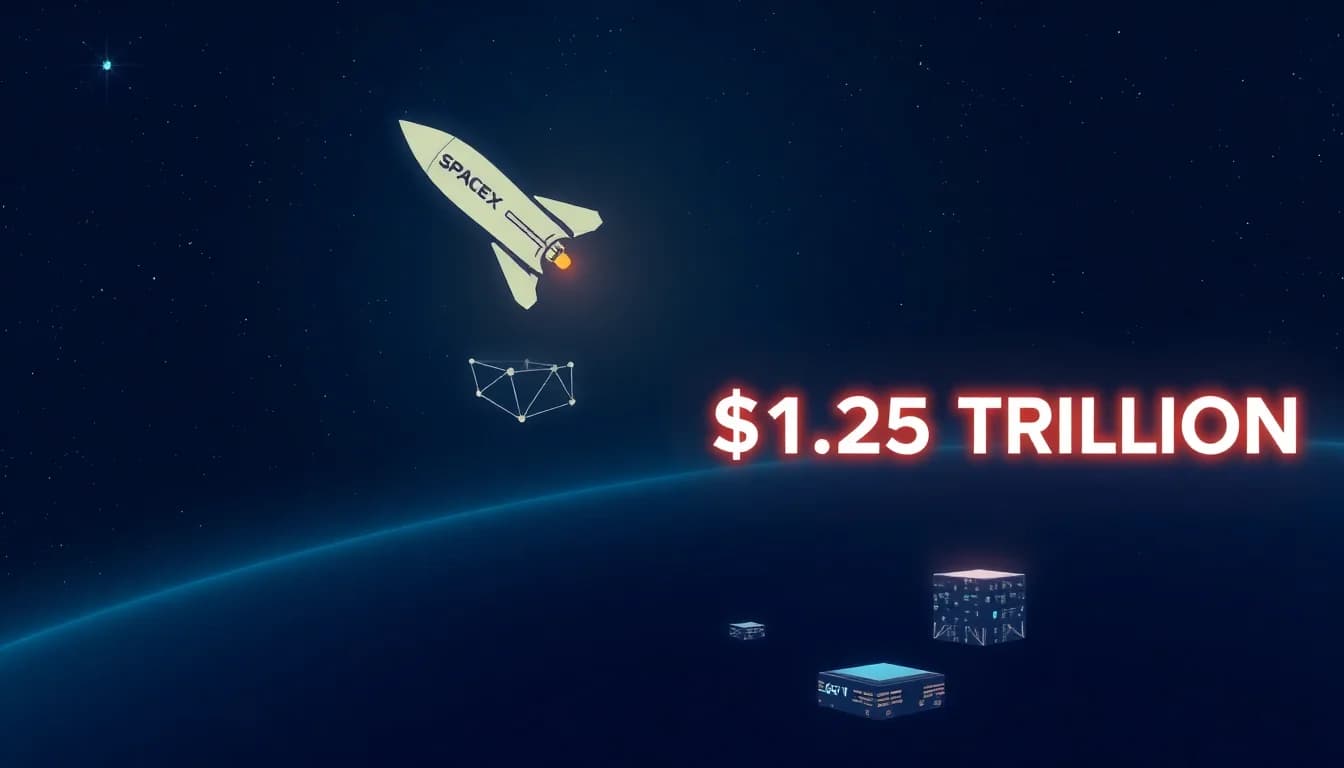
Elon Musk's space firm SpaceX has acquired his other AI startup, xAI, forming the world's most valuable private company.
The entrepreneur stated that the merger aims to establish data centers beyond Earth.
“Modern advancements in artificial intelligence rely on large terrestrial data centers that require vast amounts of energy and cooling. The global demand for electricity simply cannot be met with Earth-based solutions without harming people and the environment,” he wrote.
According to Bloomberg News, the combined company's valuation is estimated at $1.25 trillion. SpaceX plans to conduct an IPO in 2026, valuing itself at $1 trillion and xAI at $250 billion.
Both of Musk's companies are reportedly facing financial challenges, although SpaceX is in a better position.
SpaceX generates up to 80% of its revenue from launching Starlink satellites. In 2025, it reported a profit of $8 billion on revenues of $15-16 billion.
The AI startup spends about $1 billion a month and has faced investigations worldwide after it allowed the generation and distribution of explicit content on X.
The billionaire noted that establishing space-based data centers will require a constant launch of satellites, which will provide SpaceX with greater cash flow.
In February, the company requested permission from the U.S. Federal Communications Commission to launch a group of 1 million satellites for data centers. The company likely understands that the regulator will not approve such a large network and is using the inflated number as a starting point for negotiations.
The project envisions creating a network of data centers in low Earth orbit connected by laser channels. The proposal uses bold phrases like “the first step towards a Type II civilization on the Kardashev scale.”
“In my estimation, within two to three years, the most economical way to perform AI computations will be in space. The sheer cost-effectiveness will enable innovative companies to advance neural network training and data processing at unprecedented speed and scale, accelerating breakthroughs in our understanding of physics and the invention of technologies for the benefit of humanity,” Musk wrote.
Exploring Space
Space is becoming an increasingly attractive location for data centers. Advantages include virtually unlimited access to sunlight and space for equipment. The downside is the high cost of launching rockets with the necessary infrastructure.
Analysts from research group 33FG estimate that AI computations in orbit could become economically viable by 2030.
Google is among the first to explore space. The company announced a plan to create a network of satellites in low Earth orbit to harness solar energy and power data centers.
The proposed system will operate in a constantly illuminated zone of low Earth orbit, synchronized with the Sun. Devices there will be able to receive nearly continuous sunlight and maximize energy collection.
Google is also interested in managing nuclear fusion, developing relevant AI technology in collaboration with Commonwealth Fusion Systems.
The project aims to create agents that will control plasma in the SPARC reactor and optimize its operation, with the goal of approaching the creation of a virtually limitless energy source.
In November, the corporation planned to increase its AI capabilities by 1000 times—doubling every six months over the next five years.
Recall that in March 2025, the startup xAI acquired X in a deal to buy all shares, valuing the former at $80 billion and the latter at $33 billion ($45 billion minus $12 billion in debt).