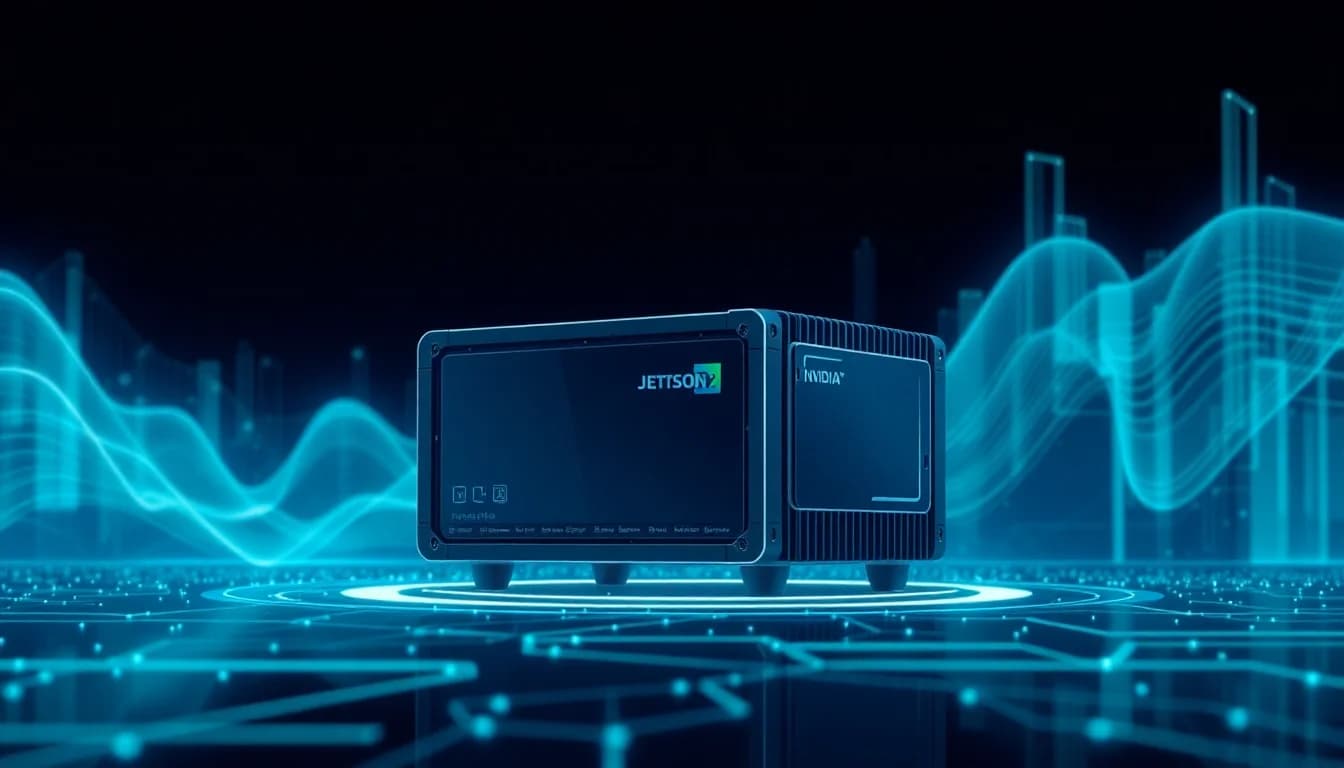
Nvidia has unveiled the Jetson Orin Nano 2, a compact computer designed for robotics and edge AI applications. This new model achieves double the inference performance while maintaining the same form factor, enabling it to run modern language and multimodal models directly on the device.
https://twitter.com/NVIDIARobotics/status/2092267694565249127
Twice as Fast
The Jetson Orin Nano 2 features an 8-core Arm processor, 8 GB of memory, and delivers AI computing performance of up to 78 TOPS. According to Nvidia, the device's enhanced Tensor Cores and increased memory bandwidth result in double the inference efficiency compared to the Jetson Orin Nano Super.
Moreover, the company has retained the compact design of its predecessor. Operating at a power consumption of 15 watts, the Jetson Orin Nano 2 maintains the same performance level while using 40% less energy.
This is particularly crucial for devices functioning at the edge, such as robots, drones, and computer vision systems, which must process data in real-time without relying on constant cloud communication.
AI Embedded in Robots
Nvidia markets the Jetson Orin Nano 2 as a platform for what it calls physical AI—systems capable of perceiving their environment, reasoning, and acting independently.
The computer supports modern models optimized for edge inference, including NVIDIA Cosmos, NVIDIA Nemotron, Gemma 4, and Qwen 3. Developers can leverage these for image and speech recognition, navigation, human interaction, and decision-making directly on the device.
Nvidia highlights that advanced compact models are now achieving accuracy comparable to larger systems from previous generations. This advancement allows for the increasing transfer of generative AI functions from data centers directly to devices.
Focus on Mass Robotics
Nvidia reports that over 3 million developers are already utilizing its robotics stack.
Among the initial companies implementing or testing the Jetson Orin Nano 2 are machine vision systems manufacturer Cognex, equipment producer Doosan Bobcat, and robotics firm Matic. The latter employs the platform for home robots that must simultaneously map environments, recognize objects, interact with people, and complete tasks autonomously.
Another application involves autonomous drones. Wing, a division of Alphabet, is using the previous generation of Jetson Orin Nano in its delivery systems and plans to evaluate the new version for improved data processing speed and energy efficiency.
Nvidia aims to make generative and agent-based AI accessible not only to large robotics firms but also to developers of relatively small autonomous devices. The Jetson Orin Nano 2 occupies the lower segment of the product line while offering computing capabilities that previously required much more substantial resources to run modern models directly on the device.
Lastly, ACE Robotics Chairman Wang Xiaogan predicts a "ChatGPT moment" for embodied AI robots by the end of 2027.