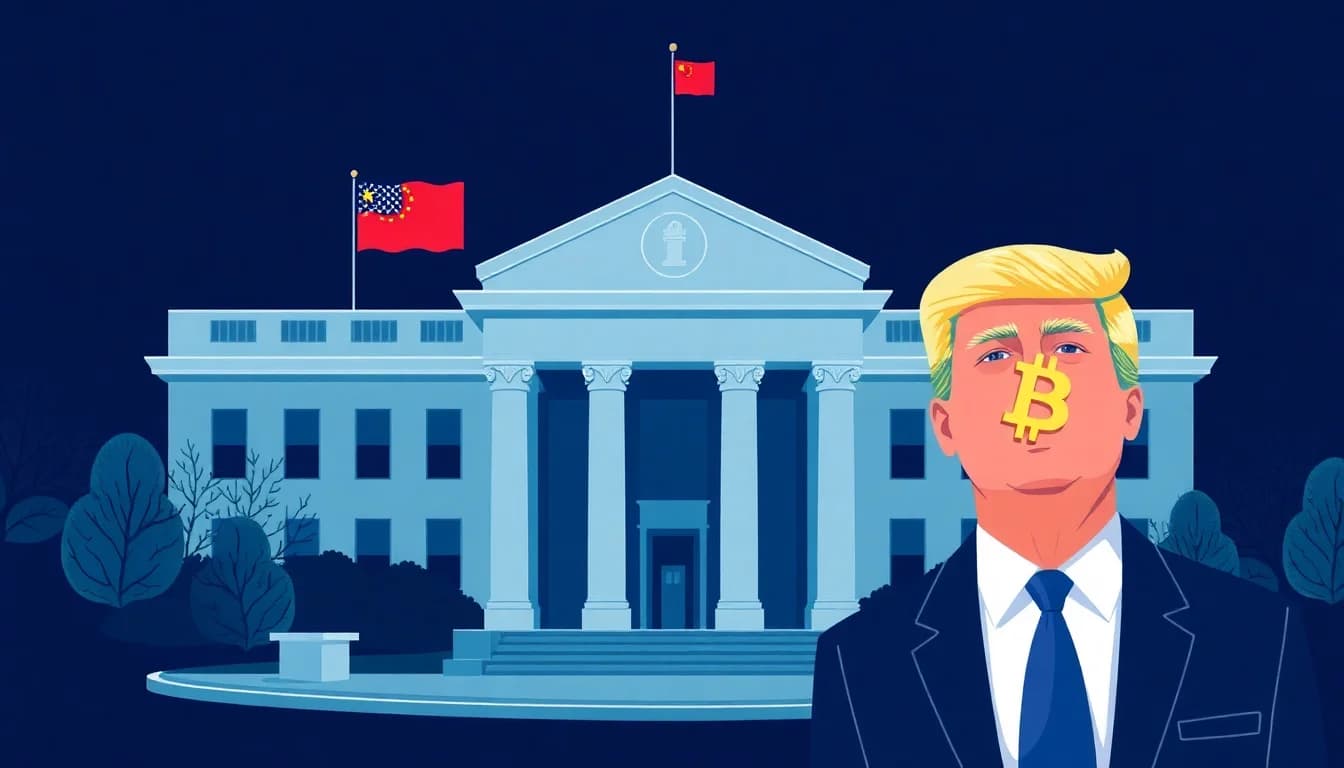
This week’s focus in "Deconstruction" is on Trump’s agreement with China, a Bitcoin supporter leading the Fed, a crypto wallet "hacked by AI," and Palantir's ideology of AI warfare.
Trump's Visit to China and the AI Market Divide
Donald Trump's first trip to Beijing since 2017 was prompted by a U.S. court's cancellation of 10% tariffs on Chinese goods, forcing both sides to discuss new rules of engagement.
Economic issues, including the purchase of Boeing aircraft in exchange for rare earth metals, were just part of the conversation. A key topic was the global restructuring of the IT market. Leaders discussed which AI technologies the U.S. would allow to be sold to China and established strict controls over autonomous weapons.
Removing trade barriers could deprive alternative markets (Vietnam, Mexico) of significant investments but may provide a lifeline for factories in Europe, which previously faced dumping from China.
Change in Fed Leadership and Banks vs. the CLARITY Act
Kevin Warsh's appointment as Fed Chair is a unique precedent. Unlike his predecessors, he is pro-cryptocurrency, personally owns coins, and describes Bitcoin as "an important asset." In the long term, this sends a strong signal toward the legalization of the industry, although his high-interest rate policy will likely suppress the growth of risky assets.
Meanwhile, the Senate is advancing the CLARITY Act, which separates the powers of the SEC and CFTC. The most heated debate centers around stablecoins. The banking lobby is pushing to prohibit crypto exchanges from offering rewards to users for holding their assets, fearing that platforms like Coinbase could become more attractive than traditional banks and siphon funds from classic deposits.
AI Recovers $400,000 in Bitcoin
After 11 years, a user was able to regain access to a wallet containing 5 BTC with the help of the chatbot Claude. Concerns arose that AI had learned to "hack" the blockchain, but the neural network simply analyzed a chaotic array of historical data.
The user uploaded the contents of an old computer to Claude, which found the necessary backup file and identified a bug in the password recovery program. The bot corrected the decryption logic and helped unlock the wallet.
While AI is a powerful tool for sorting through old data, uploading encrypted keys to online services remains a critical security risk.
Private IT Corporations Gaining Power Over the State
Palantir, which created a unified database for U.S. intelligence agencies, is now supplying the military with the Gotham system, capable of autonomously identifying targets on the battlefield.
Additionally, the corporation has begun to subtly influence government policy. Funds sponsored by Palantir and OpenAI executives pay TikTok influencers to incite panic over the "Chinese AI threat" and spend millions discrediting politicians who seek to regulate artificial intelligence.
Analysts note a structural change: while laws are formally enacted by government institutions, the actual technical infrastructure that determines what the state sees and whom it targets is increasingly under the control of private IT corporations.
This is a condensed version of the podcast. Watch the full episode:
Subscribe to the podcast: