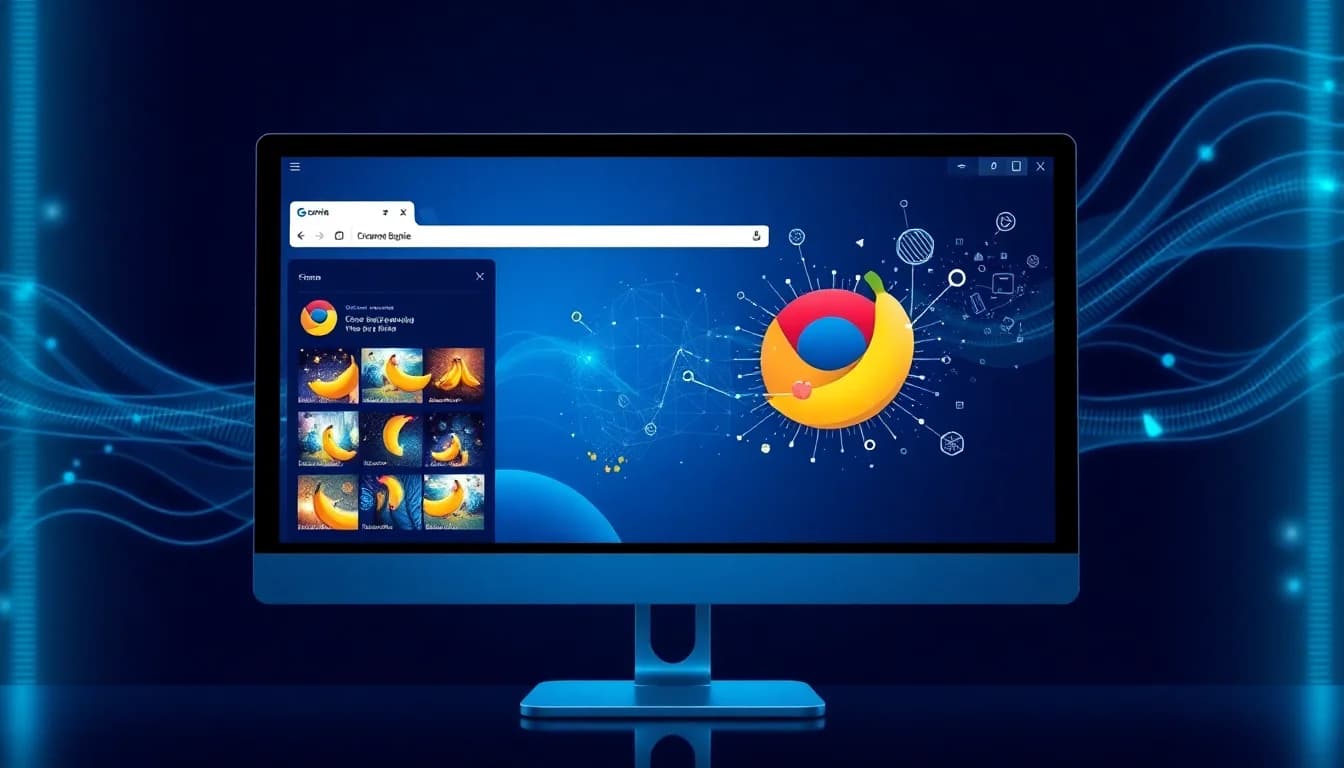
Google is integrating new AI tools based on Gemini into the Chrome browser. Key features include the Nano Banana image generator, Personal Intelligence, and Auto Browse.
Now Chrome is even better with major updates to Gemini in Chrome. Easier to use. More personalized. And more helpful than ever, with Gemini 3. 🎢
— Chrome (@googlechrome) January 28, 2026
Available in the U.S., auto browse for Google AI Pro and Ultra subscribers. pic.twitter.com/tILRW3osyO
Interface Integration
The AI assistant, introduced in September 2025 as a floating window, is now fixed in the sidebar. Users can ask questions about the website they are exploring or other open tabs.
A new feature allows the assistant to analyze multiple tabs as a cohesive unit. When a user opens different pages of the same site, the digital assistant sees them not as separate entities but as a single contextual group.
Previously, Gemini in Chrome was only available to Windows and macOS users. Following the update, it is now accessible to Chromebook Plus users as well.
Personal Intelligence
The company is utilizing a newly launched Personal Intelligence feature, which connects to Gmail, Search, YouTube, and Google Photos accounts, allowing users to ask questions based on their personal data.
This feature will roll out in the coming months, enabling users to inquire about family schedules or draft emails without switching to Gmail.
Nano Banana
This tool allows users to edit and modify images using other pictures found online as references.
Auto Browse
The AI agent can autonomously perform tasks such as clicking links, making purchases, or searching for discount coupons. It will request user intervention when handling sensitive information.
Security Risks
AI browsers are becoming a trend in the artificial intelligence sector, but they pose significant risks to users. In December 2025, OpenAI reported existing vulnerabilities.
The company acknowledged that prompt injection attacks are a concern.
"Such vulnerabilities, like fraud and social engineering online, are unlikely to be completely eliminated," stated OpenAI representatives.
Anthropic and Google share a similar stance, focusing on multi-layered security and regular stress testing.
Agentic Vision in Gemini
Simultaneously, Google introduced Agentic Vision—a feature that allows for more detailed examination of files in AI agent mode.
The company explained that next-generation LLMs like Gemini typically process information about the surrounding world in a single static glance. If they miss small details like a serial number on a microchip or a distant road sign, they "make assumptions."
Agentic Vision in Gemini 3 Flash transforms image understanding from a static action into an active process. The model behaves like a human analyst:
- assesses the overall picture;
- highlights priority areas;
- develops a hypothesis testing plan;
- digs into small details.
As a result, recognition accuracy increases by 5-10%.
Agentic Vision introduces a cycle of "think, act, observe" in image understanding tasks:
- think—the AI analyzes the user's query and the original illustration, forming a multi-step plan;
- act—the model generates and executes Python code to manipulate the image (cropping, rotating);
- observe—the transformed image is added to the model's contextual window.
Gemini 3 Flash is trained to enlarge images when detecting small details.
The beta version of Agentic Vision is available for free in Google AI Studio, Vertex AI, Gemini API for developers, and the Gemini chatbot in Thinking mode.
Recall that in December 2025, Google released the Gemini 3 Flash language model and made it the standard in the Gemini app and AI mode in the search engine.