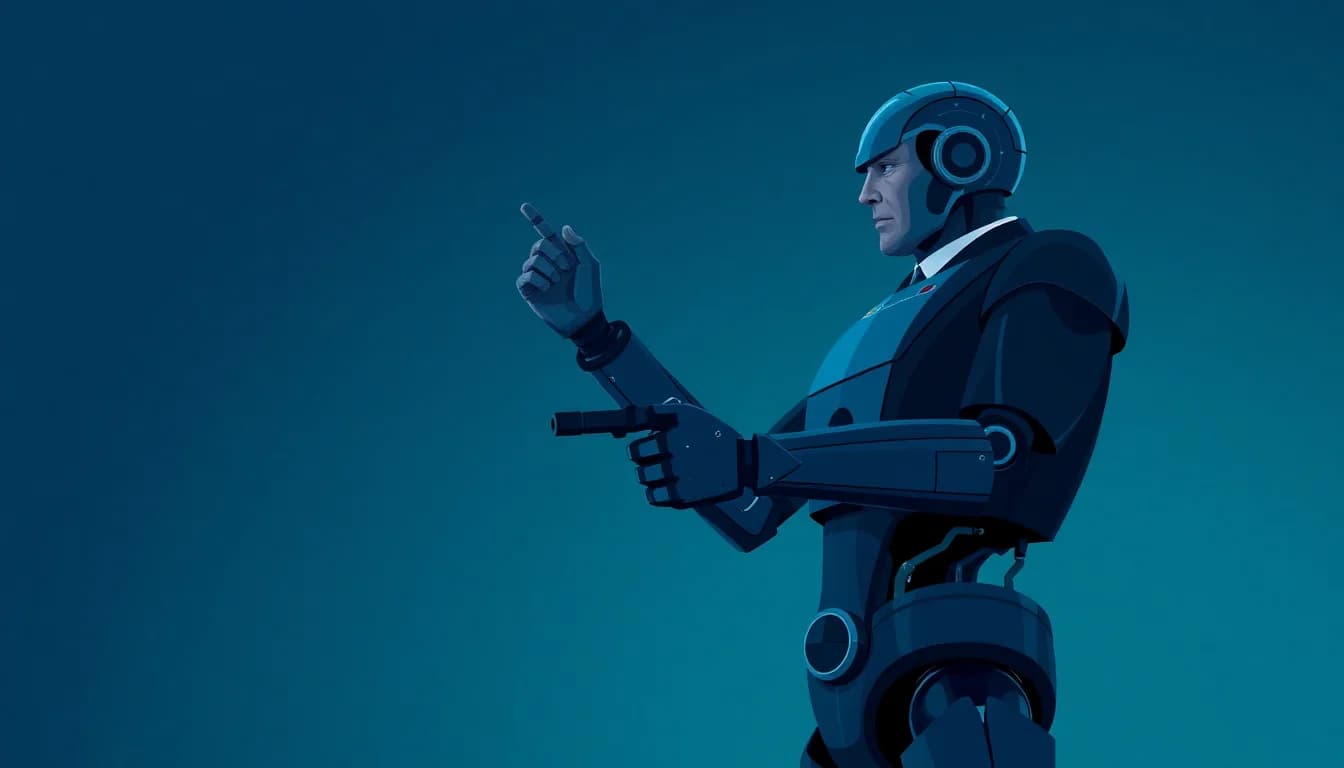
On July 17, humanoid robot manufacturer Foundation Future Industries announced plans to equip its machines with weapon systems. The first prototypes may be unveiled in the coming months, according to co-founder and CEO Sanket Pathak, as reported by WIRED.
Eric Trump, son of former U.S. President Donald Trump, serves as the investor and chief strategic advisor for the startup. Foundation is developing humanoids for logistics, reconnaissance, inspection, and potential combat operations.
The current version, Phantom MK-1, is not yet ready for full military deployment. Limitations include battery life, lack of water and dust protection, and insufficient reliability when interacting with complex objects.
Foundation Develops Weapon Systems
Pathak stated that the company is exploring several options for arming its humanoids. He did not disclose technical specifications or intended use scenarios.
"We are looking into several kinetic solutions. We will likely present something in the next couple of months," he said.
By "kinetic solutions," Pathak refers to weapon systems. Currently, these are plans for development rather than a finished combat product. The company believes humanoids will be able to navigate inside buildings, deliver cargo, conduct reconnaissance, and perform tasks in areas where wheeled or tracked vehicles are difficult to deploy.
In most operations involving weapons, a human must confirm the decision to open fire, Pathak previously stated. Exceptions may include systems that need to respond faster than an operator, such as drone and missile interception systems.
Thus, Foundation does not completely rule out fully autonomous use of force in specific scenarios. The company has not provided public rules or technical limitations for such functions.
Technical Readiness Raises Questions
The Phantom MK-1 stands about 175 cm tall and weighs approximately 80 kg. The robot can carry up to 20 kg of cargo and has proportions similar to a human. The next version is expected to include water and dust protection, Pathak added. The MK-2 release is listed as a goal for 2026 on the Foundation website.
Source: Foundation.A limitation remains the battery—robots will require more powerful energy sources or the ability to quickly replace batteries for prolonged operation. Managing the hands is also a complex task: the humanoid must not only hold a weapon but also operate safeties, reload it, and maintain control during impacts or falls.
Robert Griffin, a senior researcher at the Institute for Human and Machine Cognition, noted that it is currently difficult to separate the real capabilities of humanoids from their potential. He previously consulted for Boardwalk Robotics, which Foundation acquired. The company developed the SupplyBot humanoid for delivering supplies through narrow paths, stairs, rocky slopes, and other areas inaccessible to traditional ground vehicles.
Pioneering roboticist and MIT professor Rodney Brooks expects humanoids to reliably operate in complex, unfamiliar environments no sooner than a decade from now.
"The transition from reliable lab demonstration to initial deployment in robotics always takes at least 10 years," he stated.
This assessment contrasts with Foundation's plans to begin military use of humanoids within 12 to 18 months. Pathak dismissed the concerns as exaggerated and emphasized that robots would reduce risks for military personnel.
Contract Doubts
In April, Fox Business reported that Foundation secured a $24 million Pentagon contract. Eric Trump presented the agreement as a result of the company's efforts.
WIRED's investigation revealed a different funding structure. Foundation provided journalists with information about two contracts inherited from Boardwalk Robotics and three projects being implemented through the Institute for Human and Machine Cognition.
The publication found no confirmation that Foundation independently won a new contract for the entire stated amount. Thus, it pertains to a portfolio of related projects rather than a single $24 million agreement.
The official registry of the U.S. research support program confirms a contract for Boardwalk with the U.S. Air Force for approximately $1.8 million. This relates to the second phase of the SBIR program and involves developing a humanoid for maintenance and supply.
Source: SBIR.gov.Eric Trump is an investor in Foundation and serves as chief strategic advisor. Democratic Senator Elizabeth Warren described the connections between the president's son and the defense contractor as "corruption in plain sight."
Eric Trump went on FOX to brag about winning ANOTHER multimillion-dollar contract from the Trump administration.
— Elizabeth Warren (@SenWarren) April 23, 2026
I've been sounding the alarm and pushing for answers.
Is the Pentagon just a cash machine for Trump’s kids now?
This looks like corruption in plain sight. https://t.co/kRYgFqYSmV
"Eric Trump went on FOX to boast about winning yet another multimillion-dollar contract from the Trump administration. I am raising alarms and demanding answers. Is the Pentagon now just an ATM for Trump’s children?" the senator questioned.
Production Plans Remain Statements
According to Newcomer, at the beginning of 2026, Foundation sought to raise up to $500 million with a valuation exceeding $3 billion. Additionally, the company mentioned various production targets: one version stated it aims to produce up to 50,000 humanoids by the end of 2027, while another indicated a long-term goal of 30,000 machines annually.
However, in 2025, Foundation planned to produce about 40 robots. Achieving the stated goals will require a significant increase in production capacity.
It is worth noting that in February, Bloomberg sources reported the involvement of Elon Musk's SpaceX and xAI in a Pentagon competition to develop software for autonomous drone swarms.
Previously, the Pentagon announced the use of AI agents for simulating confrontations with foreign adversaries.