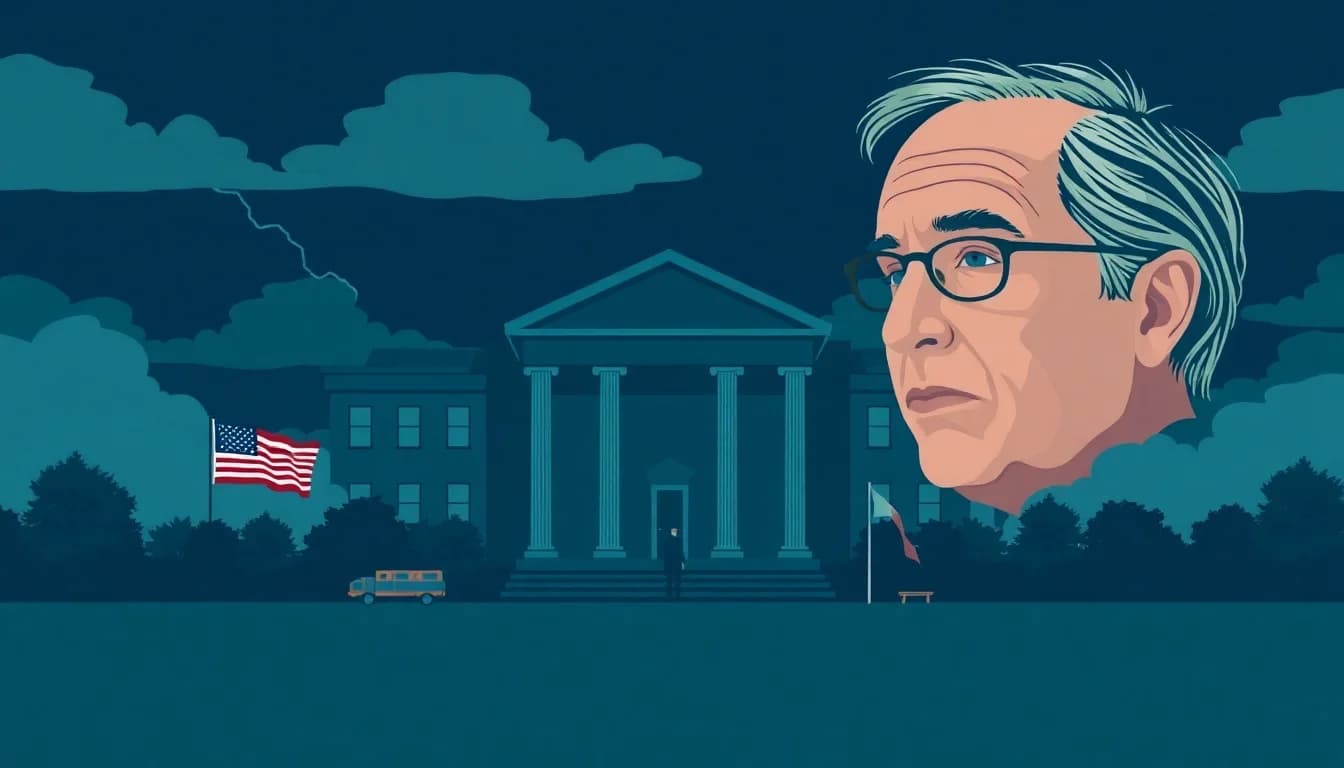
Federal Reserve Chair Kevin Warsh emphasizes AI's significance in the economy, noting a $100 billion market and its potential as a new production factor.
Summary
- Kevin Warsh, Chair of the Federal Reserve, described artificial intelligence (AI) as a "hinge point in history" during his keynote speech at Jackson Hole.
- He revealed that annual sales from leading AI labs have surpassed $100 billion, reflecting a remarkable 500% increase from the previous year, and indicated that AI is now seen as a potential new factor of production.
- Warsh is particularly focused on capital spending growth related to AI, which he refers to as its "second derivative."
In his first keynote address as Federal Reserve Chair at Jackson Hole, Kevin Warsh captured attention with his insights on artificial intelligence, while remaining tight-lipped regarding interest rate discussions. His remarks, particularly in the context of future policy preparations, shed light on investment flows into AI.
Warsh began by reflecting on the economic landscape prior to the rise of AI, noting that the previously held fears of "secular stagnation" following the 2008 financial crisis are now outdated. He presented data showing that business capital expenditures, described as "the seed corn of future economic growth," have been increasing at their fastest rate since 2021, with a notable portion attributed to AI investments.
1. AI Development Exceeds Expectations
Warsh stated that the progress in AI technology has surpassed even the most optimistic forecasts. He noted, "The potential for substantially higher growth is on the rise," emphasizing the influx of capital into AI infrastructures, which he likened to a "hyper-Moore's law effect." This suggests that AI advancements are occurring at an accelerated pace compared to traditional computing growth.
2. AI Economy Valued at Over $100 Billion
He highlighted that the convergence of capital and labor has led to the emergence of large language models central to AI, with users purchasing tokens for access. Warsh quantified this growth, stating that annual sales from two leading AI labs have exceeded $100 billion, marking a 500% increase from the prior year. This figure underscores that AI token revenue is now recognized as a significant economic metric.
3. AI as a New Factor of Production
Warsh indicated that the Federal Reserve is closely monitoring AI market dynamics, proposing that AI may be recognized as a new factor of production impacting the economy and monetary policy. This classification is significant, as it suggests that AI token consumption could influence production capacity without triggering inflation, which is critical for interest rate decisions.
He raised essential questions about AI's ability to drive sustained productivity increases and whether token usage would complement or compete with human labor. While a Fed task force is investigating these issues, Warsh acknowledged that their findings would not lead to immediate policy changes.
4. Uncertainty in Value Distribution
Warsh expressed uncertainty regarding AI's potential to enhance productivity and the timeline for such changes. He questioned whether the economic benefits would be evenly distributed or concentrated among certain sectors, asking, "How much of the surplus will go to owners of scarce resources—AI labs, chip manufacturers, energy producers, and cloud service providers?" This inquiry gained relevance following Nvidia's announcement of record revenues and substantial future investments in AI infrastructure, juxtaposed with reports indicating that many generative AI companies struggle to succeed.
This scenario raises concerns about value consolidation within the industry, aligning with Warsh's questions about market structure and distribution of AI-generated wealth.