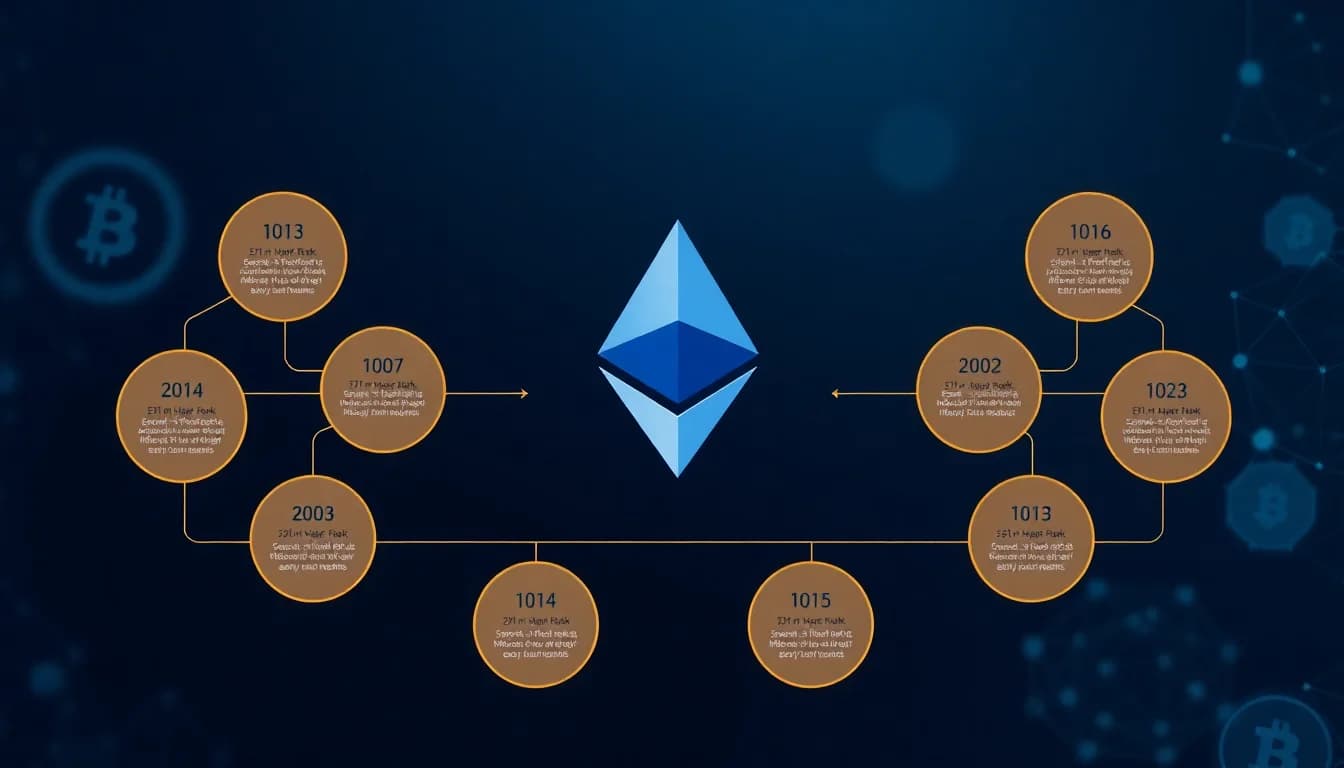
Ethereum Foundation researcher Justin Drake has introduced the strawmap—a preliminary roadmap for the protocol's development.
Introducing strawmap, a strawman roadmap by EF Protocol.
— Justin Drake (@drakefjustin) February 25, 2026
Believe in something. Believe in an Ethereum strawmap.
Who is this for?
The document, available at strawmap[.]org, is intended for advanced readers. It is a dense and technical resource primarily for researchers,… pic.twitter.com/gIZh5I8Not
“Strawmap is an invitation to view protocol updates holistically. Proposals on a single visual field provide a more comprehensive understanding of Ethereum L1 goals. […] This is not a forecast, but a coordination tool for development in the spirit of accelerationism. It offers just one of many possible scenarios,” the expert emphasized.
The document outlines approximately seven planned hard forks by 2029, with updates expected every six months. According to Drake, integrating AI into the development process could significantly shorten these timelines.
The roadmap released by the researcher is presented as a timeline. Upgrades to the consensus layer follow a “star” naming scheme (Altair, Bellatrix, Capella, Deneb, Electra, Fulu).
Currently, only two of them have confirmed names—Glamsterdam and Hegota—which are set to launch in 2026. The others are still under working titles.
Key objectives include:
- L1 speed—achieving finality in a few seconds and reducing slot time;
- L1 throughput—up to 1 gigabyte of gas per second (around 10,000 TPS) via zkEVM and real-time proof generation;
- L2 throughput—up to 1 gigabyte per second (approximately 10 million TPS) through a data availability sampling mechanism;
- L1 post-quantum security—cryptography based on hash functions;
- L1 privacy—built-in privacy through secure ETH transfers.
“Strawmap will evolve with community feedback, research progress, and governance,” Drake noted, promising to update the document at least quarterly.
Additional Details
Ethereum co-founder Vitalik Buterin commented on Drake's post, explaining how developers plan to accelerate block production and transaction confirmation.
A very important document. Let's walk through this one "goal" at a time. We'll start with fast slots and fast finality.
— vitalik.eth (@VitalikButerin) February 25, 2026
I expect that we'll reduce slot time in an incremental fashion, eg. I like the "sqrt(2) at a time" formula (12 -> 8 -> 6 -> 4 -> 3 -> 2, though the last two… https://t.co/ni9wIF2BgJ
He pointed out that in the new roadmap, “fast slots” are highlighted as a separate focus and are largely independent of other updates. Currently, the time to create a new block is about 12 seconds, with the ultimate goal of reducing it to two seconds.
Buterin stated that the reduction will be incremental—following a formula close to the square root of two: from 12 to 8, then 6, 4, and 2 seconds. A key condition is improving P2P interactions between nodes, which will allow blocks to be disseminated without excessive data load. This will make short slots safe and technically feasible.
The second key goal is to reduce finalization time from the current 16 minutes to 6-16 seconds. This will require replacing the complex existing confirmation system with a simpler, cleaner, and quantum-resistant one.
Buterin mentioned that the changes will be “very invasive.” The most significant step is planned to coincide with the transition to post-quantum cryptography, specifically to hash signatures.
“An important advantage of the incremental approach is that it allows us to make slots quantum-resistant much earlier than finalization. As a result, we can quickly reach a scenario where, in the event of a sudden emergence of powerful quantum computers, the network will lose finalization guarantees but continue to produce blocks reliably,” he summarized.
Recall that in February, Buterin called for integrating transaction simulation mechanisms into crypto wallets and smart contracts to enhance their security and user-friendliness.