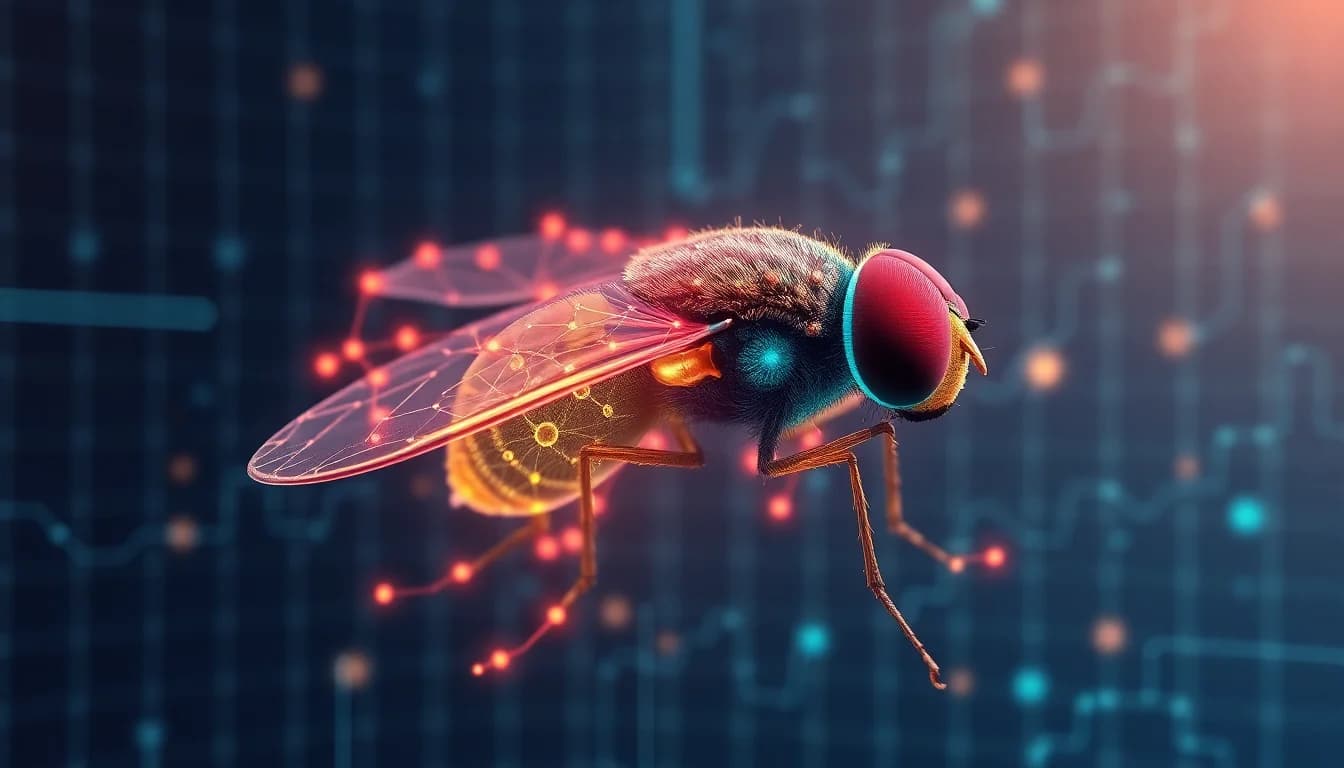
Eon Systems has modeled 125,000 neurons and 50 million synaptic connections of an adult fruit fly, placing the model in a virtual environment reminiscent of the "Matrix."
Co-founder Alex Wissner-Gross shared a video of the experiment, showcasing an animated insect that moves its legs, rubs them together, and drinks from a small bowl using its proboscis in a simulated "sandbox."
"For decades, emulating an entire brain has been an enticing analog to artificial intelligence. To replicate it neuron by neuron, synapse by synapse, and run it," Wissner-Gross wrote.
According to the scientist, this experiment represents the "world's first embodiment of a complete brain emulation capable of producing multiple types of behavior." It is based on research conducted by senior researcher Philip Shiu and his colleagues at Eon Systems.
In 2024, experts created a full computational model of the fruit fly's brain to study its neural connections responsible for feeding and body care.
The team utilized an existing project from Princeton University aimed at fully mapping the neural circuitry of the insect known as the FlyWire connectome.
The study revealed that the computational model predicts the motor behavior of the simulated fly with about 95% accuracy.
"Activation of neurons sensitive to sugar or water in the computational model accurately predicts the nerve cells that respond to taste," the article states.
Wissner-Gross noted that the scientists at Eon Systems provided the "disembodied brain" with an environment to exist.
"Sensory signals come in, neural activity spreads throughout the connectome, motor commands go out, and the physically modeled body executes them. For the first time in the history of whole brain emulation, the cycle from perception to action is closed," Wissner-Gross declared.
He added that this experiment builds on previous research, such as the work by the DeepMind team in 2025, where the neural pathways of the fruit fly were modeled using reinforcement learning.
Eon Systems aims to advance further, first creating a digital emulation of a mouse brain and then a human brain.
However, achieving this level of complexity will require immense effort, as a mouse brain contains over 500 times more neurons than that of a fruit fly.
"If we managed to close the sensorimotor loop in simulation for the fly, for the mouse, it's a matter of scale, not principle," Wissner-Gross wrote.
In July 2024, Chinese scientists developed a robot with a lab-grown artificial brain that can be taught to perform various tasks.
Thought controls the machine: how AI transforms brain-computer interfaces