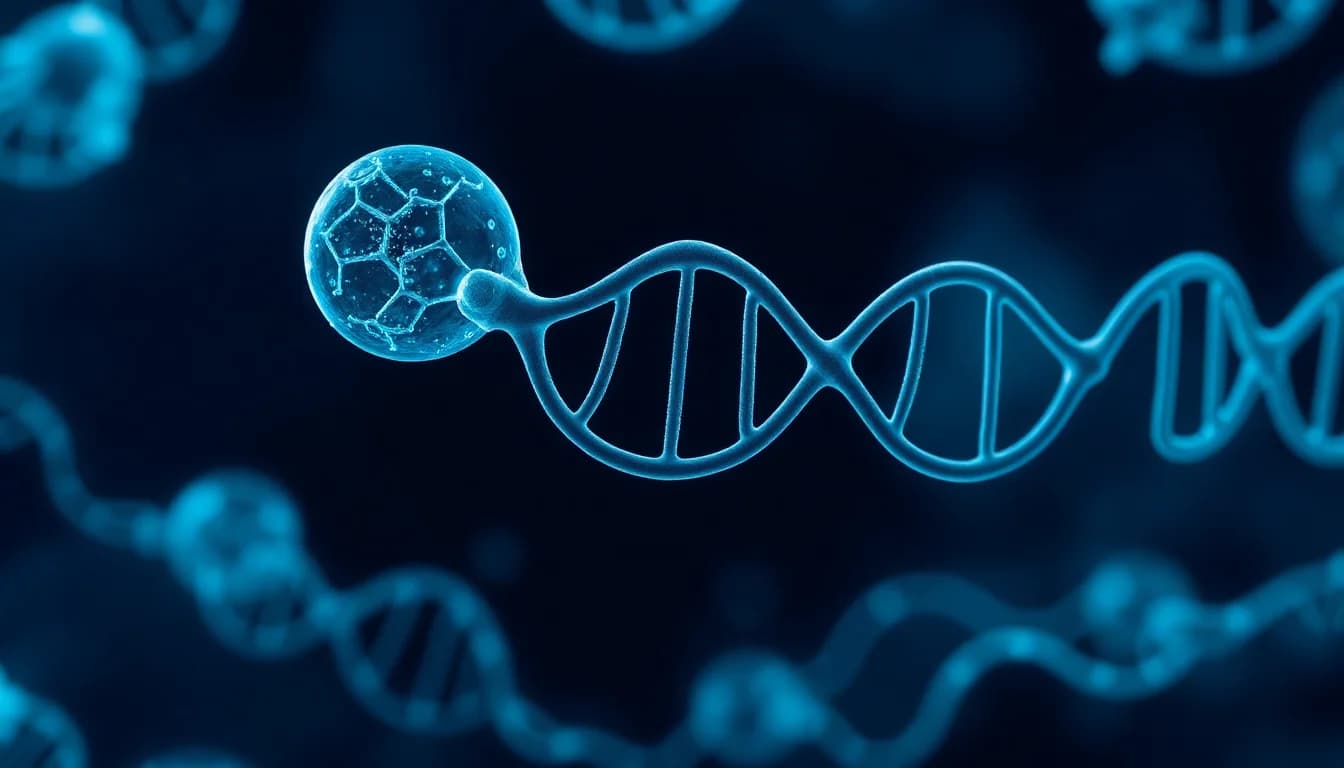
AI agents from Anthropic's Claude have revealed a novel enzyme system within the genomes of bacteriophages, which are viruses that infect bacteria.
Claude has discovered a previously unknown enzyme system hidden in the DNA of bacteriophages. Beside the enzyme’s gene sits a long array of repeating DNA—a structure that looks somewhat similar to CRISPR.
— Anthropic (@AnthropicAI) September 23, 2026
We don’t yet understand what this system does, but only a handful of known…
The newly identified system is termed array-associated reverse transcriptases (ART). Its repetitive sequences bear resemblance to CRISPR arrays.
How Claude Discovered ART
Researchers at Anthropic tasked Claude with identifying interesting examples of reverse transcriptases—enzymes that transcribe RNA into DNA. To achieve this, AI agents autonomously analyzed genomic data comprising approximately 1.9 billion protein clusters.
Over the course of 21 hours, around 950 agents compiled more than 200,000 reverse transcriptases, identified approximately 3,500 potentially new systems, and narrowed down the selection to 20 candidates for further investigation.
Anthropic estimates that a human expert would have required several weeks to months for a similar undertaking.
While studying one of the candidates, Claude detected repeating DNA sequences adjacent to the gene of an unusual reverse transcriptase. The agent measured the intervals between the repeats, compared the structure to known systems, and consulted scientific literature before forwarding the discovery to researchers for validation.
Notably, the reverse transcriptase had been previously documented in studies of a giant bacteriophage. The significant breakthrough was the identification of a larger system that includes the enzyme, an adjacent gene of unknown function, and a long array of uniformly spaced repeating DNA segments.
All laboratory experiments were conducted by Anthropic specialists, who utilized Claude to uncover patterns, formulate hypotheses, and analyze data.
The lab operates with BSL-1 and BSL-2 biosafety materials, and according to Anthropic, does not handle pathogens capable of infecting humans.
Links to CRISPR
CRISPR was originally discovered as unusual repetitive sequences in the genomes of microorganisms.
Subsequent research revealed that the regions between these repeats could originate from bacteriophage DNA and play a role in adaptive immunity against reinfection. This natural mechanism was later adapted for genome editing.
For ART, researchers also found a long array of repeating sequences, with initial experiments indicating that individual short RNAs are produced from it. This structural similarity prompted comparisons to CRISPR.
However, the function of ART remains unknown. Anthropic has not demonstrated that the system can edit DNA, recognize specific genetic sequences, or is programmable in any way.
Anthropic Strengthens Biology Focus
The discovery of ART follows a series of initiatives by Anthropic in the life sciences sector.
On September 17, the company launched a public beta of its Life Sciences Verification Program. After evaluation, research teams and organizations can access models such as Mythos 5.1, Opus 5, and Sonnet 5 with fewer restrictions for biological tasks.
Today we’re opening applications for the Life Sciences Verification Program.
— Anthropic (@AnthropicAI) September 17, 2026
Through the LSVP, life science professionals can use our models—including, for the first time, Mythos—with a new set of safeguards designed to enable the full range of biology-related work. We designed…
A separate High-risk Use tier with additional scrutiny is available for projects with elevated risk of misuse.
On the same day, Anthropic announced that Claude had optimized over 30 open models for biomolecular research in less than four weeks, accelerating their performance by approximately four times on average.
Biologists use specialized open-source models for tasks like modeling the structure of molecular systems, designing drug-like molecules, and predicting the effects of genetic mutations. But these models are often expensive to run, potentially limiting their impact.
— Anthropic (@AnthropicAI) September 17, 2026
In our latest… pic.twitter.com/WxoKAKuud1
The AI also developed a low-memory mode for processing systems larger than 10,000 molecular tokens on a single Nvidia GPU node. The optimized code has been made publicly available.
In collaboration with Adaptyv Bio, Anthropic has also launched a protein design competition, planning to experimentally validate over 5,000 proposed structures. The AI startup will provide up to $1 million in Claude credits, Modal will offer up to $250,000 in compute credits, and Twist Bioscience will supply DNA for experiments.
Earlier, project representatives disclosed that they formed a dedicated team in the spring to explore how AI could expedite fundamental discoveries in biology.
To test hypotheses, Anthropic has also established its own lab in the San Francisco Bay Area.
It is worth noting that in July, the AI startup launched the Claude Science environment for researchers and announced plans to develop therapies for "advanced" diseases.
In August, researchers from Stanford University became the first to use AI for designing complete bacteriophage genomes, with 16 of the selected and synthesized variants proving effective against E. coli.
Follow ForkLog on social media
Telegram (main channel) Facebook X