What Peter Watts' novel "Blindsight" teaches us
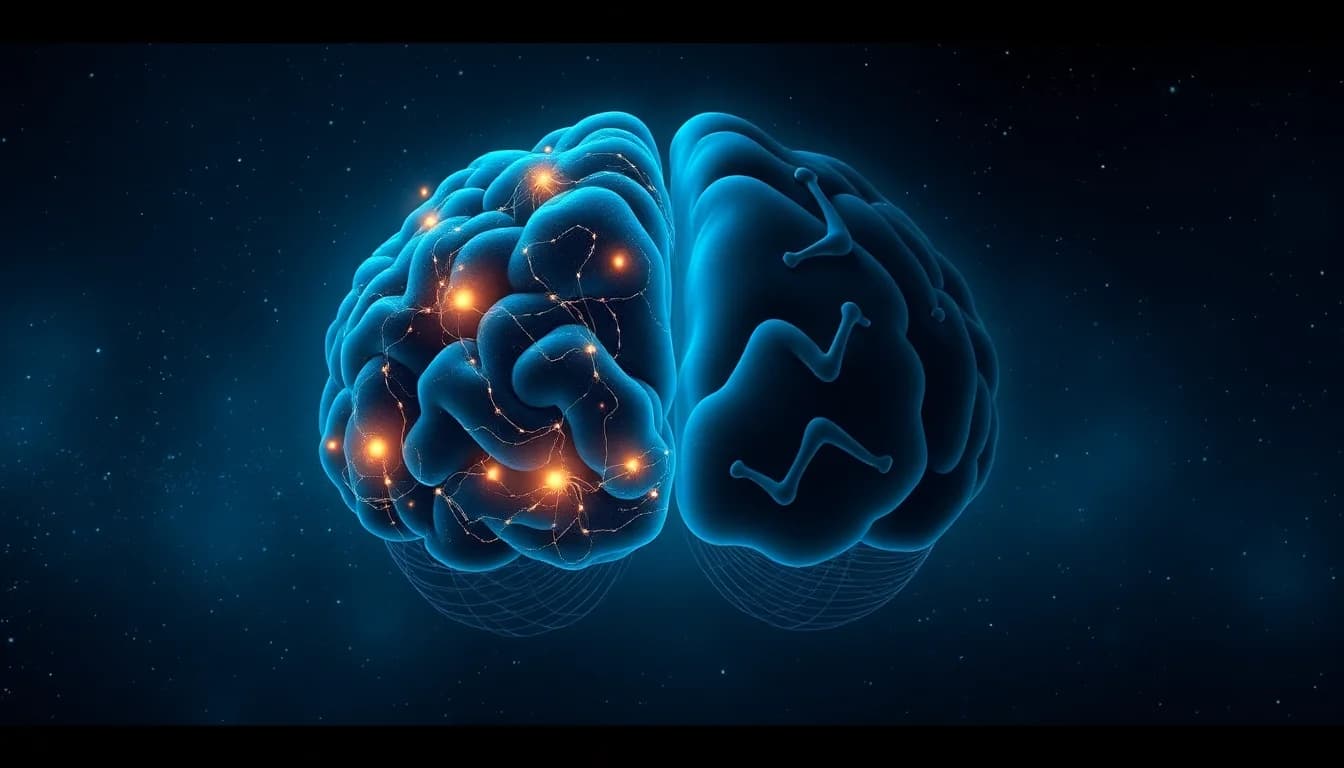
In his novel "Blindsight," Canadian biologist and author Peter Watts presents a radical hypothesis: intelligence can function effectively without consciousness. Nearly 20 years after the book's release, this thesis aptly describes generative AI.
We explore why "smart" does not equal "understanding" and the mistakes we make when we anthropomorphize algorithms.
A 2006 Novel Commenting on the 2020s
"Blindsight" was published in October 2006. The novel was nominated for the Hugo Award in 2007 and became a finalist for the John W. Campbell and Locus awards.
Its author is a marine biologist from the University of British Columbia with a PhD in zoology and resource ecology. The novel includes over 130 references to scientific works, wrapped in a familiar science fiction narrative about first contact. In the 2000s, the book remained niche, belonging to "hard" sci-fi and characterized by a heavy style and a bleak view of human nature. Critics noted its impenetrable prose and emotional coldness.
The idea of the novel is based on the distinction between two often conflated concepts: intelligence as the ability to solve problems and process information, and consciousness as the subjective understanding of what it feels like to "be" something, as philosopher Thomas Nagel formulated.
Watts proposes a provocative hypothesis: consciousness is an evolutionarily redundant trait, a byproduct rather than a necessary condition for intelligence.
The novel explores this intuition through several plotlines. The Scramblers—alien beings on the ship "Rorschach"—possess intelligence far superior to humans. They analyze the crew's neural activity and solve complex problems. However, they lack subjective experience. They do not know they exist. As Watts articulates through one character:
"Imagine you are a Scrambler. Imagine you have a mind but no consciousness, tasks but no awareness. Your nerves are buzzing with survival and self-preservation programs, flexible, self-directed, even technological—but there is no system overseeing them. You can think about anything, but you are not aware of anything."*
The protagonist and narrator, Siri Keeton, is a man who underwent a hemispherectomy in childhood to treat epilepsy. He can accurately model the behavior of others but lacks empathy and genuine emotional experience. His role is that of a synthesist, translating complex data for the control center: he transforms information without personal attachment to it. Keeton himself admits:
"It's not my job to understand. If I could understand them, they wouldn't be that advanced. I'm just, how should I put it—a conduit."
The third storyline features Yukka Sarasti, a vampire genetically resurrected from the Pleistocene with intelligence surpassing that of humans. Vampires can simultaneously perceive both sides of Necker's cube—operating multiple cognitive models in parallel.
Consciousness as Excess
Each of these characters is grounded in real philosophical concepts. The idea of philosophical zombies, introduced by Robert Kirk in 1974 and popularized by David Chalmers in his book "The Conscious Mind" (1996), describes a hypothetical being physically identical to a human but lacking subjective experience. The Scramblers radicalize this idea: they are not a copy of a human without consciousness but a fundamentally different form of intelligence.
In 1995, Chalmers articulated the "hard problem of consciousness": why do physical processes in the brain give rise to subjective experience? Even if we fully explain all cognitive functions—attention, categorization, information processing—the question remains: why is their execution accompanied by sensation? "Blindsight" flips this problem: what if the answer is "no sensation is needed"?
Watts himself described the genesis of the idea as follows: he searched for a functional explanation of consciousness and applied the same test to each possible function—can an unconscious system do the same? The answer was always "yes." He then realized that a more powerful conclusion was the absence of function altogether. In the afterword to the novel, Watts summarizes: consciousness in everyday life is occupied little more than "taking memos from a much more intelligent subconscious layer, vising them, and taking all the credit for itself."
Long before Watts, the Norwegian philosopher Peter Wessel Zapffe formulated the idea of consciousness as an evolutionary "overdose." In his essay "The Last Messiah" (1933), he compared the human mind to how "some deer in prehistoric times" went extinct due to "overly heavy antlers." Zapffe viewed consciousness as a similar evolutionary excess: a capability that developed beyond practical necessity, turning from an advantage into a burden.
However, while Watts argues that consciousness is not necessary for intelligence, the Norwegian thinker’s thesis is even more radical: it is not just redundant but destructive. He believed that humans must "artificially limit the content of consciousness" to avoid falling into a state of "cosmic panic" from understanding their own finitude.
Philosopher David Rosenthal reached a similar conclusion. In a 2008 article, he demonstrated that the consciousness of cognitive states does not add significant function beyond the processes that produce them.
Eliza in the Chinese Room
In 1980, philosopher John Searle published the now-famous thought experiment "The Chinese Room." Its essence: a person who does not know Chinese sits in a closed room with a set of rules for manipulating characters. Receiving questions in Chinese, he formulates answers according to the rules. An external observer is convinced that someone inside understands Chinese. But the person inside does not understand a word. Searle's conclusion: syntax is not identical to semantics. Correctly processing symbols does not mean understanding their meaning.
This experiment is directly embedded in the plot of "Blindsight." When the crew of the "Theseus" establishes contact with the "Rorschach," the alien ship responds in idiomatic English. Initially, this is perceived as a breakthrough—communicating with extraterrestrial intelligence. But linguist Susan James gradually realizes: the "Rorschach" learned English by intercepting human radio transmissions. It collects and combines language patterns. It produces grammatically and contextually correct responses. But it does not understand what it is saying.
Watts conveys this idea through Keeton's explanation:
"The point is that you can communicate using simple algorithms of comparative analysis without having the slightest idea of what you're saying. If you use a sufficiently detailed set of rules, you can pass the Turing test. You can be witty and humorous without even knowing the language you're communicating in."
If LLMs are the Chinese room, why do millions of people behave as if there is an understanding entity behind the interface? The answer lies in cognitive biases shaped by evolution.
In 1966, AI pioneer Joseph Weizenbaum at MIT created ELIZA, a program that used simple pattern matching to simulate a psychotherapist. It reformulated user responses into questions. The effect astonished the creator himself: his assistant, who observed the development, asked to be left alone with ELIZA after just a few minutes of interaction. Weizenbaum later wrote:
"I never imagined that a very brief interaction with a relatively simple program could induce powerful delusional thinking in completely normal people."
This phenomenon is known as the "ELIZA effect"—the tendency to attribute understanding to computer systems that they do not possess. The effect persists even when users know they are interacting with a program.
This is a cognitive distortion. We evolved to recognize kin, and language is one of the strongest diagnostic markers of belonging to Homo sapiens. Watts describes this mechanism in the novel through the character Robert Cunningham, who explains why an unconscious entity would be indistinguishable from a conscious one:
"An intellectual automaton will blend into the background, observe those around it, imitate their behavior, and act like an ordinary person. And all this—without being aware of what it is doing, not even aware of its own existence."
Murray Shanahan, a professor of cognitive robotics at Imperial College London and a senior researcher at Google DeepMind, warns:
"Careless use of philosophically loaded words like 'thinks' and 'believes' is particularly problematic because such words obscure the mechanism and actively encourage anthropomorphism."
Scramblers Write Code
In 2024, Watts told Helice magazine in an interview that: "Twenty years ago, I predicted things that are happening today. But now I have no idea what will happen in the next twenty years."
One of the main lessons of the novel is not about predicting technologies. It is a warning about a cognitive trap: consciousness is not necessary for effectiveness. Scramblers solve problems better than humans without subjective experience. LLMs write code and translate languages without understanding.
We anthropomorphize not because AI deceives us, but because our brains are wired to seek reason in language. The ELIZA effect, described back in 1966, has been amplified many times by systems trained on billions of texts.
The novel teaches us to distinguish what a system does from what a system is. The ability to not confuse imitation with understanding remains one of the most valuable skills. Watts articulated this thought two decades before it became practical.
Text: Sasha Kosovan