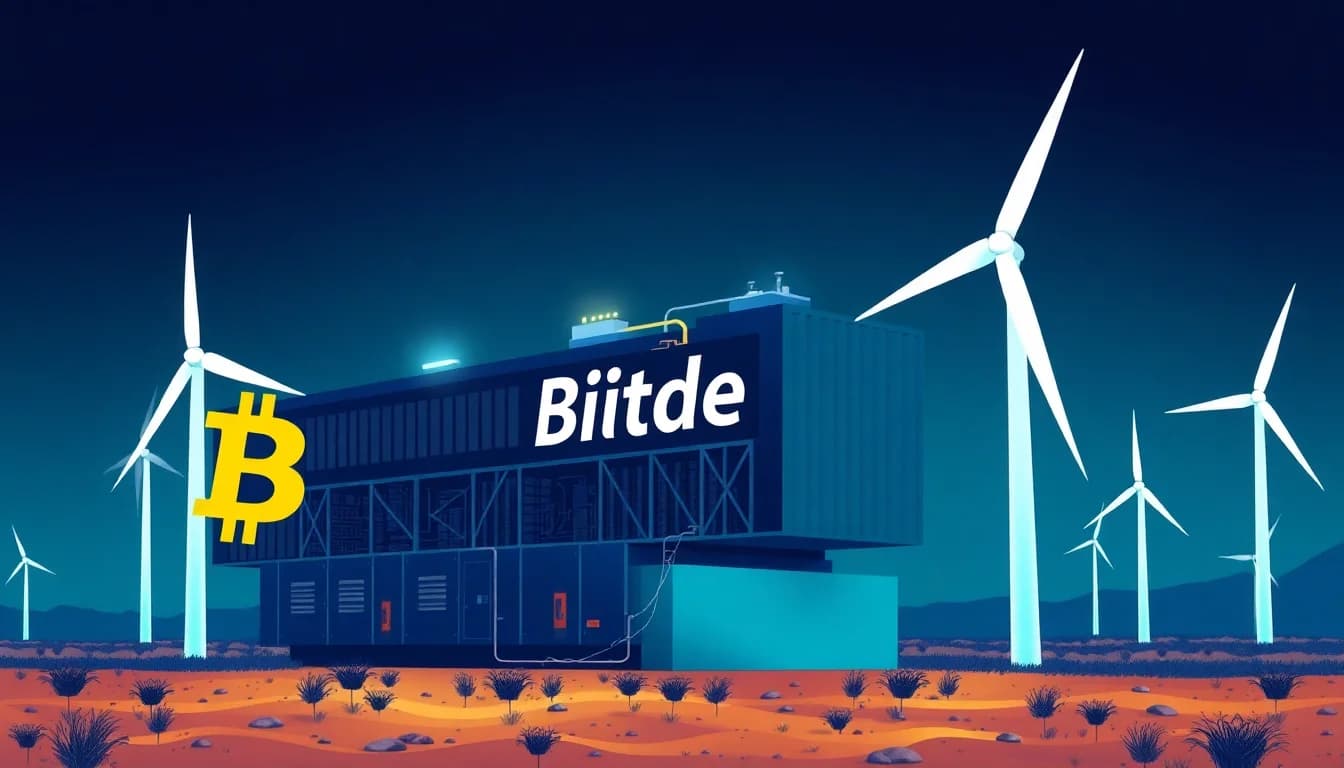
Bitdeer is set to establish Bitcoin mining facilities with a total capacity of 28 MW at the Soluna wind energy site in Texas. The equipment located at the Kati 1 site will contribute approximately 1.93 EH/s to the company's hash rate.
Wind-Powered Mining
The installation process will commence in September and will be executed in phases. A key feature of this initiative is its energy source; Kati 1 is a wind-powered data center connected to the Las Majadas wind farm, which has a total capacity of 83 MW.
Bitdeer will supply its own ASIC miners, the Sealminer A2 Pro Air. Soluna will provide the site, electricity, and oversee operational management. The revenue generated from mining will be shared between the two companies, although the financial terms and duration of the agreement have not been disclosed.
Project Benefits
Once all the planned equipment is installed, Bitdeer expects to add about 1.93 EH/s to the site's hash rate. However, Kati 1 is designed for a much larger scale, with Soluna previously estimating the total potential capacity of the project at 3.5 EH/s.
This deal offers the data center operator another avenue to monetize its available renewable energy through computational tasks. The company is building infrastructure directly next to energy sources and will utilize it for Bitcoin mining, with plans to extend into AI and HPC sectors in the future.
In this model, cryptocurrency mining acts as a consumer of wind energy right at the production site. This approach allows for the conversion of available power into computational load without the need for separate infrastructure typically required by traditional consumers.
Moreover, Soluna is gradually diversifying its business model. The second phase of the Kati project is expected to accommodate over 100 MW of AI/HPC infrastructure.
This year, Bitdeer surpassed long-time leader Marathon Digital Holdings (MARA) in Bitcoin mining capacity. As of June 30, the company's operational hash rate reached 73 EH/s, marking an increase of over 340% in the past year.
Source: ZIVEN.This growth occurs against a backdrop of a declining trend in the sector, as public miners (excluding Bitdeer) have decreased their realized hash rate by 21% since the fourth quarter of 2025.
Bitcoin Mining Difficulty Stagnates
On August 23, the mining difficulty of Bitcoin decreased by 1.3% to 125.81 T following a recalibration.
This metric has returned to levels seen in mid-February (125.86 T).
The Bitcoin hash rate, measured using a seven-day moving average, stands at 867.4 EH/s. The network's computational power has been trending downward since October 2025, when it peaked at 1.15 ZH/s amid historically high cryptocurrency prices.
Source: Classnode.Miners Shift Towards AI
In the first half of 2026, 15 public Bitcoin miners and AI infrastructure operators invested $30.7 billion in equipment, a 42.6% increase compared to the entire year of 2025, according to BlocksBridge Consulting.
Nine cryptocurrency miners in the sample reported a 52% increase in revenue from HPC, AI cloud, and colocation services, totaling $205.8 million compared to $135.4 million in the previous quarter. Companies like Core Scientific, TeraWulf, Bitdeer, and IREN were included in this analysis.
TeraWulf received regulatory approval in August from the state of Kentucky for energy supply to its Justified Data Campus data center, which has a capacity of 482 MW. The company plans to utilize this site to meet a 20-year contract with Anthropic for providing 401 MW of critical IT load.
https://twitter.com/TeraWulfInc/status/2091862234070684103
This agreement is expected to generate approximately $19 billion in revenue for TeraWulf during the first phase alone. The company estimates that development and construction costs for the data center will range from $4 billion to $4.5 billion, based on projected costs of $10 million to $12 million per MW.
Additionally, Bitdeer has signed a five-year contract worth around $400 million with an undisclosed client, covering about half of the capacities at the A102 data center in Malaysia.