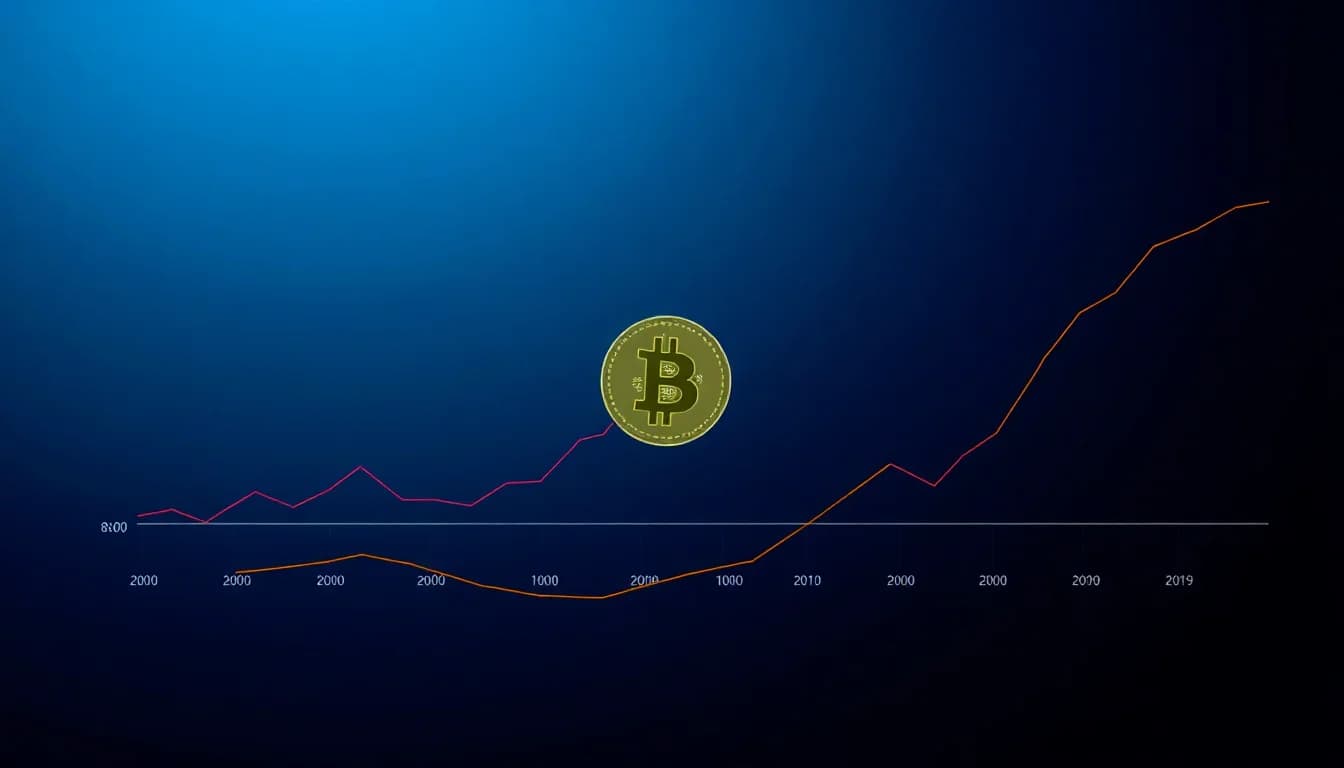
A significant 50% decline from its recent peak has pushed Bitcoin into a historically labeled dead zone, igniting discussions among cryptocurrency analysts.
By Olivier Acuna|Edited by Oliver Knight Jun 24, 2026, 2:47 p.m. 4 min readMake preferred on ShareShare this articleCopy linkX (Twitter)LinkedInFacebookEmailMake preferred on The current position of Bitcoin on the Rainbow Chart has led some holders to see it as a prime buying opportunity, while others have differing views. (Blockchaincenter.net)SummaryShow- Bitcoin has dipped below the lowest band of the long-established Rainbow Chart for only the second time, entering the original model's "Bitcoin Is Dead" zone around $62,500.
- Experts are divided on whether this breach indicates that Bitcoin is underpriced or if the Rainbow Chart has become obsolete, given the influence of ETFs, institutional investors, and macroeconomic factors.
- Many analysts now consider the Rainbow Chart and similar models more as sentiment indicators rather than predictive frameworks, highlighting Bitcoin's increasing maturity and liquidity which have diminished the four-year boom-and-bust cycles these models were based on.
Bitcoin has recently fallen below the bottom band of the well-known Bitcoin Rainbow Chart for the second occasion in its history, a model that has monitored BTC's long-term price movements for over ten years.
Some of the most dedicated Bitcoin enthusiasts think the chart is signaling a significant buying opportunity. CryptoRover made comparisons on X this past Wednesday, referencing the last time Bitcoin was in this zone back in 2022, when it hit $15,000 before reaching a cycle low.
Currently, Bitcoin is trading around $62,500, which is approximately 50% lower than its record high of $126,000 from October 2025. This decline has taken BTC beneath the floor of the updated nine-band Rainbow Chart and into the original model's purple "Bitcoin Is Dead" zone, a position that has historically indicated extreme pessimism rather than a forecast about Bitcoin's future.
This situation has led to differing opinions among analysts regarding whether Bitcoin is significantly undervalued or if the Rainbow Chart itself is becoming less relevant as institutional investments, exchange-traded funds (ETFs), and macroeconomic dynamics increasingly influence the market.
The Rainbow Chart was created by a Reddit user named Azop in 2014. It employs a logarithmic growth curve to depict Bitcoin's long-term price trajectory, dividing the asset's value into colored bands that represent various stages of market sentiment.
Opinions among analysts vary regarding the implications of this breach for Bitcoin and the Rainbow Chart itself.
Markus Levin, co-founder of XYO, remarked to CoinDesk, "The first time price breaks below a band that has held for over a decade indicates that there's a structural shift in the model. I do not interpret this as Bitcoin being dead; rather, I see it as the Rainbow Chart losing relevance, which can be viewed positively as it reflects the asset's maturation."
Still a valuable reference
Ryan Lee, the chief analyst at Bitget, expressed a contrasting view. "The Rainbow Chart continues to be a valuable tool for visualizing long-term market cycles, but it should not be regarded as a predictive model," he stated.
Lee continued, "The chart relies on logarithmic regression and past price behaviors rather than fundamental, macroeconomic, or market structure variables that are increasingly influencing Bitcoin today."
Emad Shahin, COO of Ethra, added that the chart serves better as a sentiment gauge than a forecasting instrument. "The Rainbow Chart is a fitted regression with a sense of humor, not a forecasting tool. These charts are helpful as sentiment illustrations, but when treated as predictive, they fail precisely when you need them most," Shahin told CoinDesk.
Bitcoin reached a peak of $126,000 in October without reaching the upper red bands of the Rainbow Chart. Now, with BTC near $62,500, it has dropped below the chart's floor.
This discrepancy occurs as other popular Bitcoin valuation models have also faced challenges. The Stock-to-Flow model, which connects Bitcoin's price to its programmed supply reductions, forecasted considerably higher prices after the 2024 halving than what Bitcoin ultimately achieved.
Mark Zalan, CEO of GoMining, concurred that the bottom band does not imply a permanent downturn.
Bitcoin dead zone
"The 'Bitcoin is Dead' zone does not mean Bitcoin is actually dead," Zalan remarked to CoinDesk. "Historically, it has often indicated phases of extreme fear and undervaluation that were typically followed by recoveries. It reflects sentiment rather than certainty."
Zalan acknowledged the chart's usefulness but noted it is "less accurate than it once was."
"The 2025 cycle demonstrated that BTC does not have to adhere strictly to previous patterns," Zalan explained. "ETFs, institutional involvement, and evolving market structures have shifted the dynamics."
Bitcoin is currently trading near its April 2024 halving price, a trend that contradicts expectations for the ongoing four-year cycle.
Levin indicated that the chart reflects what the "cycle data has been showing us; the exponential growth assumptions embedded in this chart were designed for a retail-driven, illiquid asset, not a $1.25 trillion market influenced by ETF flows and institutional balance sheets that determine the marginal price."
"The chart is starting to depict an asset that no longer behaves as it used to," Levin stated.
"These bands are based on a regression fitted to volatile four-year cycles, but that volatility may be diminishing as institutional capital and ETF flows transform Bitcoin into a more stable, liquid asset," Levin remarked.
Growing institutional involvement
Lee also discussed how, with increased institutional adoption and participation, “ETF flows, derivatives activity, and macro conditions are playing a larger role in price discovery; historical models alone have become less dependable as standalone indicators.”
Lee noted that weak sentiment does not necessarily equate to inevitable further declines. "Current positioning near the lower end of the Rainbow Chart indicates weakened sentiment, but it does not necessarily mean significantly lower lows are on the horizon," Lee explained.
"A drop toward the low-$50,000 range cannot be dismissed if risk sentiment worsens, but the chart itself provides limited insight into where a definite market bottom might form."
The future of Bitcoin regarding whether it will rebound into the Rainbow Chart's historical range or continue trading outside of it may influence the model's continued relevance for investors or lead it to join a growing list of crypto valuation frameworks that no longer accurately reflect market behavior.
Bitcoin NewsRelated AssetsBitcoin$60,918.892.39%Latest Crypto News- 1The banking lobby is wrong about stablecoins and community banks13 minutes ago
- 2Gold, silver and bitcoin tumble as debasement trade unwinds1 hour ago
- 3Bitcoin could fall to $55,000 before finding a bottom, 10x Research says1 hour ago
- 4CoinDesk 20 performance update: Aave (AAVE) gains 5.9% as index moves higher 1 hour ago
- 5CZ, Binance founder, wants to clear up 'misunderstandings' about who he is 2 hours ago
- 6Aave could soar to $3,500 by 2030 on DeFi revival, says StanChart2 hours ago
- 7This forgotten coin could surprise everyone before its next halving3 hours ago
- 8Bitcoin clings to $62,500 as bears tighten grip on crypto market3 hours ago
- 9YZi Labs ends proxy war with BNB treasury company CEA Industries4 hours ago
- 10Cboe revives S&P 500 binary options, chasing a market popularized by Polymarket, Kalshi4 hours ago
CEX Volumes Drop to Lowest Since September 2024 as RWA Perps Hit Record High
CEX Volumes Drop to Lowest Since September 2024 as RWA Perps Hit Record High
In May, combined exchange volumes fell 3.45% to $4.41T; the lowest since September 2024. RWA perpetual futures volumes rose 10.4% against the trend, hitting a new all-time high.
By CoinDesk ResearchJun 15, 2026In May, combined exchange volumes fell 3.45% to $4.41T; the lowest since September 2024. RWA perpetual futures volumes rose 10.4% against the trend, hitting a new all-time high.
Why it matters:
In May, combined exchange volumes fell 3.45% to $4.41T; the lowest since September 2024. RWA perpetual futures volumes rose 10.4% against the trend, hitting a new all-time high.
View Full ReportMore From Markets