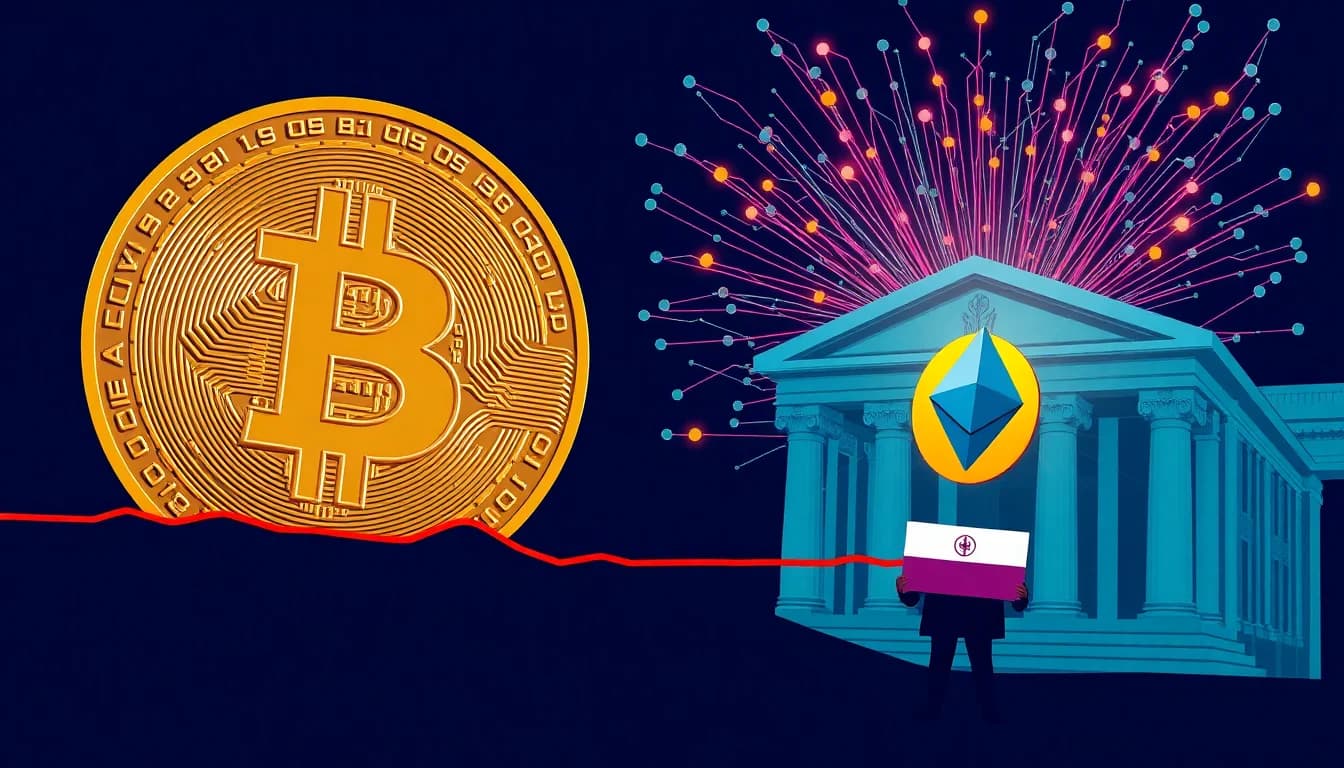
Digital gold couldn't hold above $90,000, Ethereum's mainnet surpassed L2 in activity, Iran's central bank purchased over $500 million in stablecoins, and other events from the past week.
Seller Pressure
On Monday, the leading cryptocurrency began with a nighttime correction. The asset sharply broke below support around $95,000 and headed towards $90,000.
This decline continued throughout the week, with significant selling pressure on Bitcoin. The situation was exacerbated by downturns in the U.S. and Japanese stock markets.
By Wednesday, digital gold hit a local bottom at $87,000.
By the end of the week, the flagship cryptocurrency traded in a range from $88,000 to $91,000. At the time of writing, the coin is around $89,000.
According to analysts at Glassnode, the supply pressure remains: recent buyers are creating resistance, limiting growth potential. Short-term rallies are being used to exit positions (distribution).
Attempts to establish a foothold above are met with selling from investors who accumulated positions in Q1 to Q3 of 2025.
CryptoQuant researcher Julio Moreno noted that, for the first time in history, the share of "new" whales in the realized capitalization of the first cryptocurrency exceeded that of long-term holders.
The average purchase price for the first group is around $98,000. Since spot prices are lower, investors are facing a total unrealized loss of $6 billion.
The rest of the crypto market followed Bitcoin's dynamics. Ethereum fell below $3,000 (-12% for the week), while BNB dropped below $900 (-7.5%).
The Crypto Fear and Greed Index returned to the "extreme fear" zone at 25 points, down from around 50 last week.
The dynamics of inflows into crypto ETFs were also negative. Investors withdrew $1.33 billion from spot Bitcoin funds and $611 million from Ethereum products.
Source: SoSoValue.
The total market capitalization of the crypto market decreased to $3.08 trillion. Bitcoin's dominance index stands at 57.5%, while Ethereum's is at 11.5%.
Activity in Ethereum
Token Terminal analysts recorded the beginning of a "return to the Ethereum mainnet." Amid record-low fees, activity on the mainnet surpassed that of layer two solutions.
The mainnet outpaced L2 protocols in terms of daily active users. On January 16, the figure peaked at approximately 1.3 million addresses. After a correction, it stabilized at around 945,000 daily, still exceeding metrics from Arbitrum, Base, and OP Mainnet.
Source: Etherscan.
At the same time, there is a liquidity outflow from layer two. According to L2Beat data, the total value locked (TVL) in the rollup ecosystem decreased by 16% over the year and now stands at $45 billion.
Experts linked the surge in Ethereum activity to the December Fusaka update, which significantly reduced gas fees. However, much of the traffic may have "artificial origins" and not reflect the actions of real users, specialists warned.
Source: Etherscan.
Blockchain security expert Andrey Sergeenkov suggested that the spike in activity was caused by a wave of "address poisoning." He believes the situation is a mass spam attack.
After Fusaka, fees on the network dropped by more than 60%. This made fraudulent schemes profitable: attackers remain in the black even with a victim conversion rate of 0.01%.
Meanwhile, JPMorgan analysts expressed doubts about the long-term sustainability of Ethereum's successes.
"Historically, successive blockchain updates have not significantly increased activity on a sustainable basis for various reasons," the bank noted.
Topics to Discuss with Friends
- Billionaire called Bitcoin an easy target for confiscation.
- Bitwise announced the end of the bear market.
- The Winklevoss twins donated $1.16 million to Zcash developers.
- The Ethereum Foundation formed a post-quantum security team.
Blockchain Initiatives in Bhutan and Bermuda
The sovereign fund of the Kingdom of Bhutan, Druk Holding and Investments (DHI), and the Sei Development Foundation agreed to deploy a validator in the Sei network within the country.
This partnership aims to expand the national blockchain infrastructure. The parties plan to explore opportunities for asset tokenization, test new economic models, and penetrate data assessment and DeSci.
The initiative will be implemented by DHI's innovative division, InnoTech, with support from venture firm Sapien Capital. The node is expected to be operational in the first quarter of 2026.
Currently, the Kingdom of Bhutan ranks seventh in the world among Bitcoin-holding countries. The government owns 5,985 BTC (~$529 million), primarily obtained through mining.
This week, the Bermuda government also announced a national-level blockchain initiative. The government plans to create "the world's first fully on-chain economy."
Technical partners for the initiative include Circle and Coinbase. The implementation plan consists of several stages:
- Government agencies will begin pilot acceptance of payments in "stablecoins."
- Financial institutions will implement tokenization tools.
- Businesses will gain access to global finance through digital wallets.
The transition to blockchain aims to address the issue of expensive bank transfers. Traditional payment gateways are often unprofitable for island jurisdictions and reduce profits for local entrepreneurs. Using the USDC stablecoin will enable fast and cheap transactions.
Iranian Stablecoins
Elliptic specialists discovered that Iran's central bank purchased USDT stablecoins worth $507 million.
The bulk of the assets was acquired in the spring of 2025. Under sanctions and disconnection from the SWIFT system, cryptocurrencies have become the only alternative for international bank transfers for the country.
According to researchers, before the hack in June, most of the central bank's funds were directed to the Nobitex platform, which was the largest crypto exchange in Iran for exchanging and selling digital assets for the local currency (Iranian rial).
After the attack, the regulator switched to a more complex scheme using decentralized cross-chain bridges and DEX, primarily in the TRON and Ethereum networks.
Elliptic attributed the purchases to economic instability in Iran amid the devaluation of the rial.
"The main motivation for acquiring USDT is the desire to control currency markets. This aligns with blockchain activity. The allocation of funds to Nobitex indicates a strategy to inject dollar liquidity into the local market to support the rial," they noted.
Experts believe the central bank attempted to halt the currency's decline by buying fiat with USDT on the exchange. The regulator is also building a "sanction-proof" banking mechanism.
Also on ForkLog:
- OpenAI introduced age filtering in ChatGPT.
- Vitalik Buterin criticized modern DAOs and called for their reform.
- Ripple predicted close integration of stablecoins with the banking system.
- A solo miner earned $289,191 for mining a Bitcoin block.
Tokenization from NYSE
The New York Stock Exchange (NYSE) announced the development of a platform for trading and on-chain settlement of tokenized securities.
The service, which requires regulatory approval for launch, will provide 24/7 trading access, instant settlements, and the ability to place orders in dollar equivalents.
The new NYSE project will support stablecoins.
Technically, the platform will combine the NYSE Pillar matching engine with blockchain-based post-trading systems, ensuring support for settlements across various networks.
The platform will work with tokenized stocks that are interchangeable with traditional securities and native digital assets. Token holders will retain rights to dividends and participation in company governance.
Only qualified broker-dealers will be allowed to access the service.
NYSE President Lynn Martin noted that the exchange aims to combine trust in traditional markets with modern on-chain solutions while maintaining high investor protection standards.
The exchange's parent company, Intercontinental Exchange, is also working on adapting its clearing infrastructure for 24/7 operations through tokenized deposits.
Further Reading
We analyze the plans of Ethereum developers and assess prospects in light of upcoming updates.
Moderately paranoid Elena Vasilieva discusses why crypto enthusiasts believe in conspiracy (and why they might be right).