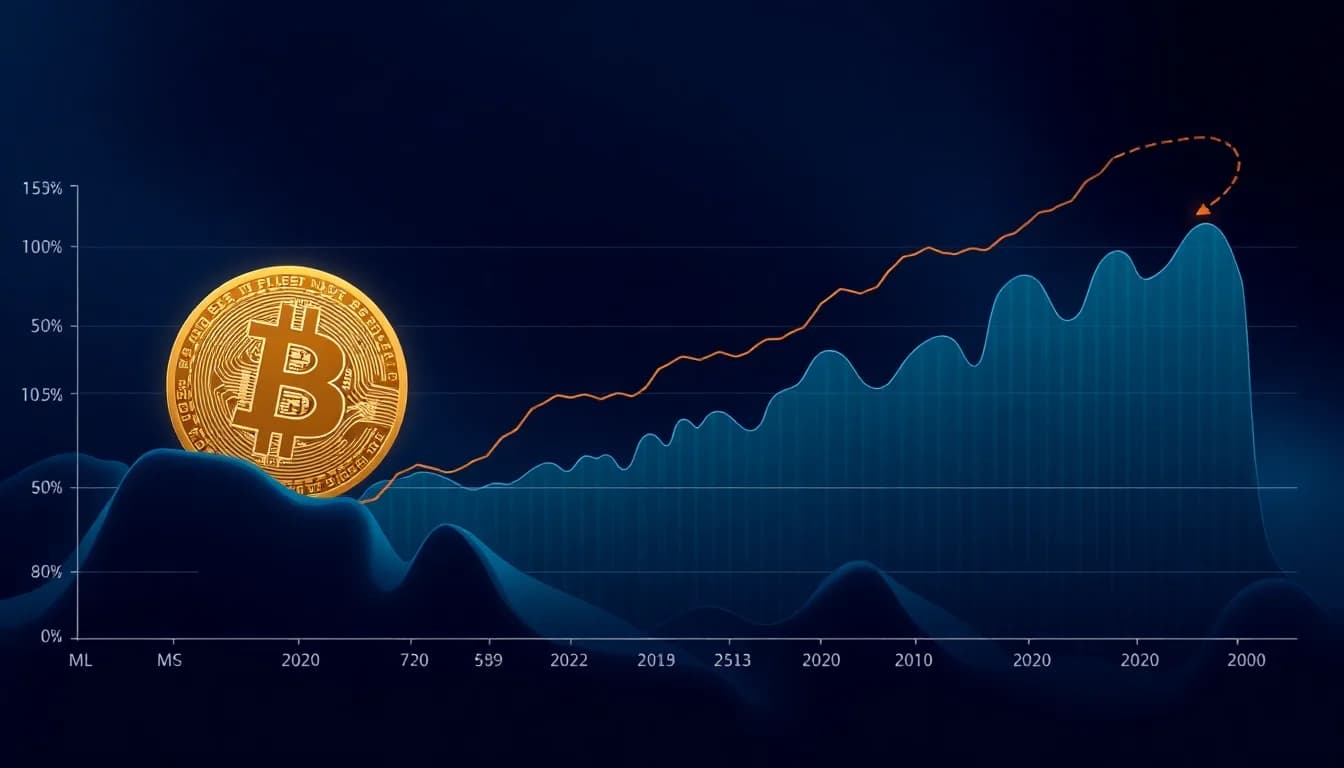
Valuations influenced by M2 money supply growth indicate worrying patterns for risk assets.
By Omkar Godbole|Edited by Shaurya Malwa Jun 17, 2026, 6:30 a.m. 2 min readMake preferred on ShareShare this articleCopy linkX (Twitter)LinkedInFacebookEmailMake preferred on Valuations adjusted for money supply highlight concerning trends. ( Frederick Warren/Unsplash/Modified by CoinDesk)SummaryShow- When accounting for the U.S. M2 money supply growth, both bitcoin and the S&P 500 show a less favorable outlook than their nominal values imply.
- On a money-supply-adjusted basis, the S&P 500 has only recently revisited its dot-com-era peak.
Simply observing the dollar value of your investments might overlook critical insights shaped by the growth of the money supply.
From a superficial perspective, the markets appear stable. Bitcoin has dropped nearly 50% to $66,000 from its peak of $126,000 in October of the previous year, which some might view as a typical crypto bear market. Meanwhile, the S&P 500 remains close to its all-time highs.
However, a more intriguing narrative unfolds when these prices are adjusted for the U.S. M2 money supply. M2 reflects the Federal Reserve's assessment of liquid assets, encompassing cash, checking and savings deposits, and other short-term savings tools like money market funds and certificates of deposit.
Signs of Monetary Exhaustion?
Some analysts regard bitcoin as a sensitive indicator of dollar liquidity, and the BTC/M2 ratio, which adjusts bitcoin's price relative to money supply growth, is now signaling caution. Following a significant rise from 2023 to 2025, this ratio appears to be forming a head-and-shoulders pattern, often interpreted as a bearish indicator.
BTC's price-to-U.S. M2 money supply. (TradingView)If this pattern remains valid, it may suggest that bitcoin's previous advantage over money supply growth — which allowed it to effectively counteract debasement in earlier cycles — is diminishing. Currently, bitcoin might be nearing a point where its capacity to exceed the influx of new dollars is yielding smaller returns.
This situation extends beyond the crypto realm. Bitcoin has historically been viewed as a leading signal for overall risk sentiment, and the S&P 500's valuation adjusted for money supply presents a narrative that diverges from its nominal price.
S&P 500-to-U.S. M2 (TradingView)The index is currently situated near a record high of 7,511 points, significantly above the 2000 nominal peak of approximately 1,500 points. Yet, when adjusted for two decades of M2 growth, the S&P 500 has only recently matched its 2000 peak. This does not necessarily indicate that equities are as inflated as they were during the dot-com bubble, given that present corporate earnings are generally seen as stronger and more resilient than those in 1999-2000.
However, on this money-supply-adjusted basis, it has required 25 years of money-supply growth merely to bring the index's value back to where it was at the dot-com bubble's peak. In essence, every new dollar injected into the system has had to work increasingly harder to achieve relatively smaller gains in valuation.
Conclusion
Bitcoin has sometimes anticipated broader macroeconomic shifts. If its monetary valuation is genuinely waning relative to M2 growth, it could serve as an early indicator that the nominal gains in the S&P 500 are less solid than they seem.
Whether this will lead to actual weakness in equities remains uncertain, but when the asset most sensitive to liquidity begins to show signs of struggling against the growth of dollar supply, it warrants careful consideration for the broader risk-oriented market.
Bitcoin NewsLatest Crypto News- 1BitGo offers Europe’s crypto firms a MiCA-compliance lifeline as license deadline looms26 minutes ago
- 2Crypto PAC's $12 million Senate candidate, Barry Moore, wins Alabama GOP primary 1 hour ago
- 3Live markets: A bitcoin bottom signal flashed as holders absorbed 125,000 BTC in June2 hours ago
- 4XRP gives back breakout gains, slipping below $1.23 on heavy selling2 hours ago
- 5Uniswap jumps 22% and altcoins rip while bitcoin stalls before the Fed2 hours ago
- 6Here is why Strategy's dividend-paying crypto stock is crashing to near-historic lows9 hours ago
- 7Bitcoin miners' AI pivot faces $50 billion reality check, says VanEck10 hours ago
- 8U.S. senators urge Treasury not to leave states out of GENIUS Act stablecoin process10 hours ago
- 9Hyperliquid, Uniswap and Worldcoin buck crypto slump as traders chase AI, DeFi trends10 hours ago
- 10Coinbase introduces AI advisor, stock options, and pre-IPO markets in finance push12 hours ago
CEX Volumes Drop to Lowest Since September 2024 as RWA Perps Hit Record High
CEX Volumes Drop to Lowest Since September 2024 as RWA Perps Hit Record High
In May, combined exchange volumes decreased by 3.45% to $4.41T; the lowest level since September 2024. RWA perpetual futures volumes rose by 10.4% against this trend, achieving a new all-time high.
By CoinDesk ResearchJun 15, 2026In May, combined exchange volumes decreased by 3.45% to $4.41T; the lowest level since September 2024. RWA perpetual futures volumes rose by 10.4% against this trend, achieving a new all-time high.
Why it matters:
In May, combined exchange volumes decreased by 3.45% to $4.41T; the lowest level since September 2024. RWA perpetual futures volumes rose by 10.4% against this trend, achieving a new all-time high.
View Full ReportMore From Markets