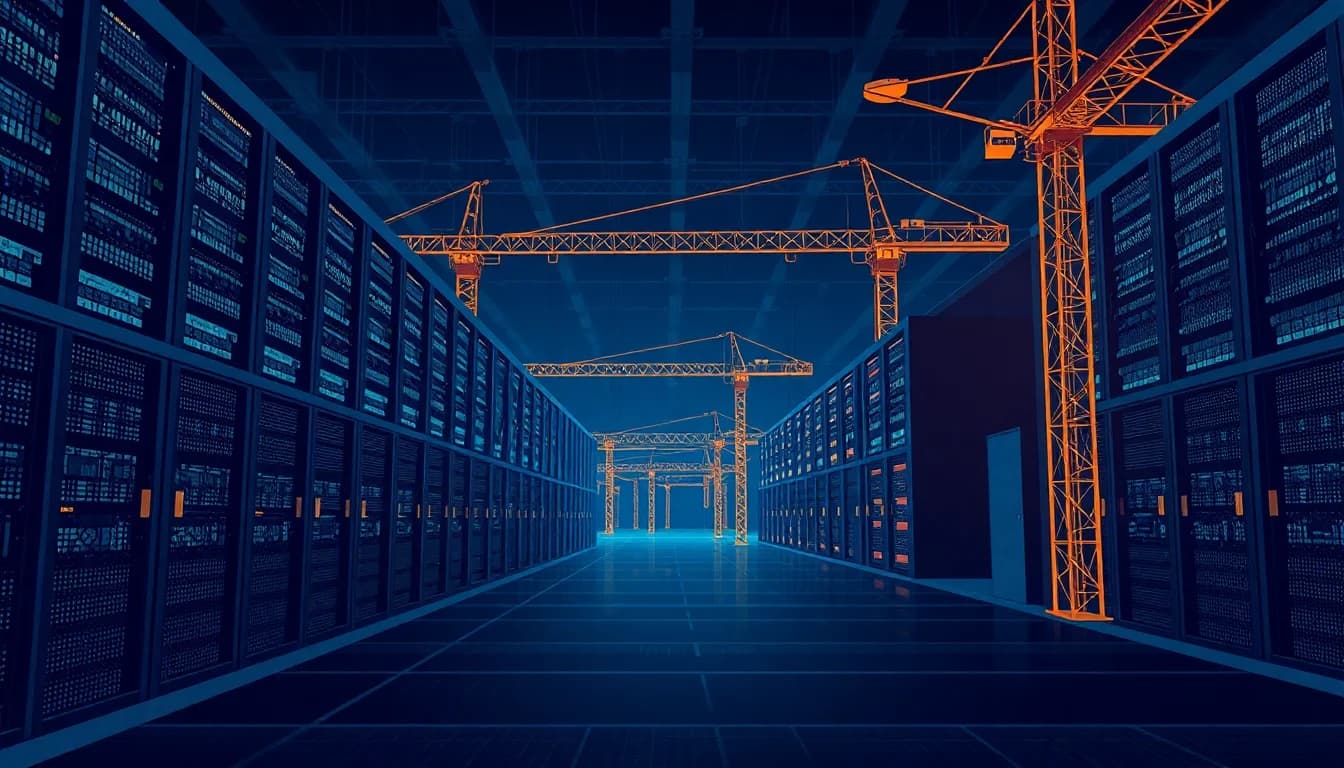
Construction of nearly half of the data centers in the U.S. has been put on hold.
The artificial intelligence industry is facing a barrier that cannot be overcome with money or new generations of chips. A global shortage of energy networks, a lack of components, and resistance from local communities have made the construction of data centers one of the most complex logistical and political challenges for the tech sector.
What fundamentally distinguishes AI data center architecture from traditional data centers, why the industry has become increasingly dependent on China, and how communities are overthrowing local authorities in attempts to protect themselves from noise and environmental disasters are explored in this new ForkLog article.
Architectural Specifics
Traditional data centers, which have supported the internet economy for the past twenty years, are fundamentally different from the architecture required for working with large language models.
A classic data center is CPU-oriented and consumes an average of 5 to 10 kW of electricity per server rack, whereas AI tasks on GPUs require about ten times more power. Machine learning racks with Nvidia H100 or B200 accelerators demand between 40 to 120 kW each. This difference in energy density affects the basic physics of the facilities.
A cluster of tens of thousands of GPUs at peak load consumes electricity equivalent to that of a small industrial city. The problem is that distribution networks and substations are typically not designed to handle such spikes in consumption in isolated areas.
The appetites of AI industry leaders have depleted stocks of critical components for power supply: high-voltage transformers, generators, and batteries for uninterruptible power systems. Manufacturing capacities in the U.S. and Europe are struggling to meet order volumes. As a result, the wait time for industrial transformers, primarily from China, has increased from one or two years to three to five years.
The growing dependence of the American market on Chinese components contrasts sharply with the current political climate. Source: Bloomberg.
Another issue is heat dissipation. Air cooling cannot cope with the density of AI servers. The industry is forced to switch to liquid cooling systems like Direct-to-Chip or immersion tanks. These require millions of liters of purified water and pose a threat to regions, especially in arid climates.
According to data from Dutch expert Alex de Vries-Gao, AI systems worldwide consumed about 765 billion liters of water in 2025. To conserve this natural resource, developers are improving mechanisms. Instead of traditional cooling towers, where water evaporates into the atmosphere, new data centers are increasingly equipped with closed-loop systems. In these systems, water circulates through pipes, absorbs heat, cools in radiators, and returns to the servers with minimal volume loss. However, the pace of implementing this technology lags significantly behind the speed of new data center construction.
Almost at Stargate
An unprecedented budget, support from top government officials, and the status of the main AI alliance of the decade. At the start, the Stargate project had everything—at least on paper.
Stargate is an ambitious initiative worth $500 billion, announced by U.S. President Donald Trump in January 2025 as part of a national campaign to maintain technological dominance. A joint venture between OpenAI, SoftBank, and Oracle was supposed to be the main driver of AI data center infrastructure expansion.
A year after the loud announcement, the joint venture had yet to assemble a full team or secure any major contracts for construction.
The situation worsened in financial markets. JPMorgan Chase, which was supposed to organize the issuance of $38 billion in debt for Stargate, faced investor doubts about the project's profitability.
OpenAI CEO Sam Altman and SoftBank founder Masayoshi Son disagreed on fundamental issues: where to build the facilities and who would control them. From September to October 2025, Stargate executives made multiple trips to Tokyo for tough negotiations with Son, but they could not resolve who would own the platform for the flagship campus in Abilene, Texas.
OpenAI considered independently executing the project, but lenders refused to provide funds without a clear path to profitability.
Stargate abandoned its ambitious goals and freed up space for 900 MW, retaining basic capacities in Texas aimed at 1.2 GW in the future. Partners shifted their expansion focus, and in April 2026, developer Related Digital, in collaboration with Oracle, secured $16 billion in debt and equity financing to build a new mega data center in Michigan for OpenAI's needs.
Meanwhile, competitors took advantage of Stargate's uncertainty. In late March 2026, the vacant 900 MW was seized by Microsoft, becoming a new partner of Crusoe Energy to expand the campus in Abilene. The upgrade will increase the total capacity of this facility to 2.1 GW by mid-2027 using Nvidia GPUs.
People Against
Data centers are no longer seen as a straightforward economic driver—they create minimal jobs after construction is completed, yet they burden networks, consume water, and generate constant noise.
In April 2026, residents of Festus, Missouri, protested against a $6 billion data center project. Locals successfully removed four of the eight city council members and launched a petition to dismiss the remaining members, including the mayor.
On April 9, residents filed a lawsuit against the city, claiming that the Festus authorities did not provide the public enough time to review the proposal before making a decision and made illegal zoning changes for the project. The lawsuit also alleges that the city participated in private meetings regarding the project instead of public ones.
The approved project for an unnamed developer is set to occupy 360 acres of land.
In recent months, a series of similar events have occurred in the U.S.:
- In February 2026, the New Brunswick city council (New Jersey) rejected a data center deal under public pressure, deciding instead to use 27,000 square feet of property for a public park;
- In the same month, a proposal to annex land into the city limits of Foristell (Missouri) met resistance from citizens concerned that the land would be used for a data center. Ultimately, the decision was changed, and the land retained its agricultural status;
- In September 2025, Prince George's County (Maryland) paused projects for data center development after local protests and formed a task force to study the risks;
- In St. Charles (Missouri), less than an hour's drive from Festus, efforts are underway to permanently ban data center construction after a moratorium was imposed in August 2025.
A data center in New Brunswick was canceled tonight when hundreds of residents showed up. When we fight big tech and private equity, we win. pic.twitter.com/doZ63Pdwue
— Ben Dziobek (@BenDziobek) February 19, 2026
The growing trend of opposition to data center construction has increased demand for transparency and access to real-time data. The "Data Center Moratorium Tracker in the U.S." team is investigating the companies behind unnamed deal participants and tracking all locations where authorities have officially imposed temporary bans on new data centers.
According to the dashboard, as of April 14, 2026, there are 58 active moratoriums in the U.S.
Source: "Data Center Moratorium Tracker in the U.S.".
Well, then, to space
Energy shortages, delays in components, and public protests have led to stagnation in the industry.
According to Bloomberg, construction of about half of all planned data centers in the U.S. has either been postponed indefinitely or completely canceled. Of the projected capacities, less than a third are in active construction.
Tech giants and independent developers are seeking alternative ways to place computing power—from the ocean floor to outer space.
Between 2014 and 2024, Microsoft explored submerging sealed server capsules underwater. The last major test of the Project Natick took place off the coast of the Orkney Islands (Scotland) from 2018 to 2020, where a capsule containing two racks of 864 servers was submerged to a depth of about 35 meters.
Over two years underwater, only six computing units failed. In comparison, eight times more equipment failed in the control group on land. This was attributed to the inert nitrogen inside the capsule, the absence of temperature fluctuations, and the human factor—often a cause of failures.
The server capsule off the coast of the Orkney Islands (Scotland). Source: Microsoft.
Researchers noted that the ocean provided free and infinite heat dissipation, and contrary to fears, the data center "did not harm the ecosystem." Moreover, an artificial reef formed around the capsule, attracting fish.
Despite the success, the project was closed due to its inapplicability to the AI sector and logistical issues. Any physical intervention requires ships to be adjusted, the multi-ton capsule to be raised from the seabed, and then resealed.
How will this task be managed in space? At the end of 2025, experts from the 33FG research group calculated that by 2030, AI computations in orbit will be cheaper than on Earth.
In February, SpaceX applied to the U.S. Federal Communications Commission for permission to launch a group of 1 million satellites for data centers into orbit. The project aims to create a network of data centers connected by laser channels.
The logic behind space data centers relies on two factors: access to round-the-clock solar energy and low temperatures for ideal natural cooling.
However, the concept faces significant commercial and physical barriers. SpaceX management warned about the risks of unprofitability for such projects at the current stage.
The main challenges of the concept include:
- launch costs. Despite decreasing prices per kilogram of payload, sending heavy server racks with tungsten shielding against cosmic radiation remains extremely expensive;
- signal delay. For inference (real-time operation of a neural network with a user), milliseconds are crucial. Transmitting large data sets from Earth to orbit and back introduces delays that make the system unsuitable for certain tasks. Such data centers may only be suitable for asynchronous model training;
- maintenance. Replacing a failed GPU in space is impossible. The lifespan of equipment is strictly limited by its fault tolerance in radiation conditions.
Other projects are also actively participating in the space initiative: Google announced its intention to create a satellite system in low Earth orbit to harness solar energy and power data centers, while Nvidia announced the creation of a computing platform for space data centers.
In 2026, California startup Aetherflux plans to launch solar mini-farms in the form of satellites into orbit to transmit energy from space to Earth using lasers.
On April 27, 2026, Meta secured a deal to supply 1 GW from space for its data centers with another startup. According to the developer of the extraterrestrial power station Overview Energy, the first orbital demonstration of the system is expected in 2028, with commercial deliveries anticipated in 2030.
The development of AI infrastructure has faced physical and administrative limitations. The high energy consumption of new GPU clusters, the need for water resources for cooling, and the strain on local power grids have led to a reassessment of data centers by the public and municipalities. As a result, scaling ground computing power has transformed from a matter of available capital into a complex logistical and social challenge.
Initiatives to create orbital data centers, despite current costs and maintenance barriers, are becoming a pragmatic response to the ground infrastructure crisis. In the coming years, companies' ability to solve the problem of physically placing equipment will determine the pace of further development of computing systems.